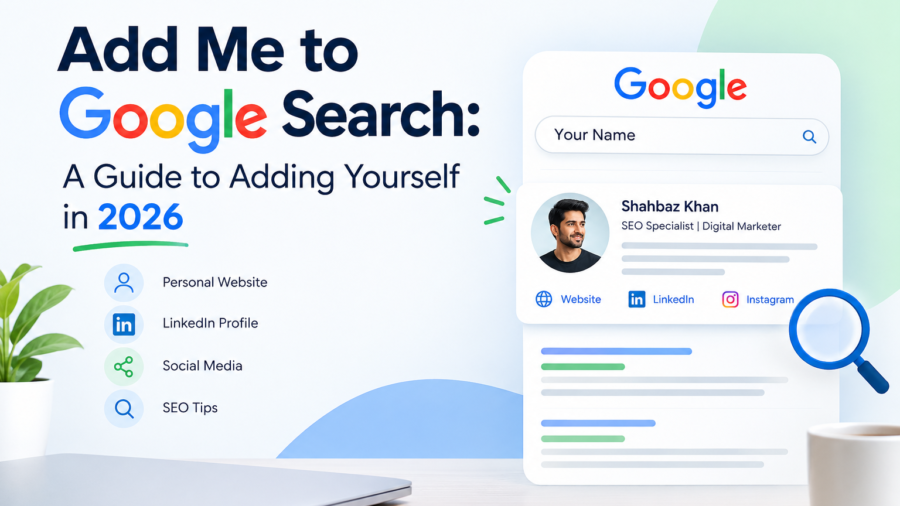
Add Me to Google Search blog image

Add Me to Google Search: A Guide to Adding Yourself in 2026

Have you ever searched for your name on Google and found little or no information about yourself? If you want people to find your name, work, or professional profile online, you can take a few simple steps to improve your visibility.

“Add Me to Google Search” usually refers to making your personal information easier to discover through Google. There is no single form that guarantees your name will appear in search results. Instead, you can create public profiles, build a personal website, and help Google discover your online information.

In this guide, you will learn how to make yourself more visible on Google in 2026.

What Does “Add Me to Google Search” Mean?

Adding yourself to Google Search means creating an online presence that Google can find and potentially show in its search results.

For example, if you are a freelancer, student, business owner, or digital marketing professional, you may want people to find your name, experience, skills, or website when they search for you.

Google discovers public web pages and decides which ones to include in its search results. You cannot manually add every personal detail to Google or guarantee a particular ranking.

Is Google People Card Still Available in 2026?

Google People Cards were introduced to help individuals create a simple public profile that could appear in Google Search. Users could share information such as their name, occupation, location, and professional details.

However, Google discontinued the People Cards feature in 2024. As a result, you cannot create a new Google People Card using the old feature in 2026.

The good news is that you can still build your online presence through other methods, including a personal website, LinkedIn, and public professional profiles.

How to Add Yourself to Google Search in 2026

Follow these practical steps to help people discover your name and professional information online.

1. Create a Personal Website

A personal website is one of the best ways to present your information in one place. You can use it to introduce yourself, share your skills, display your work, and provide contact details.

You can create a website using platforms such as WordPress or other website builders.

Include the following information:

  • Your full name
  • A short introduction about yourself
  • Your profession and skills
  • Your work experience or portfolio
  • Links to your professional profiles
  • Contact information you are comfortable sharing publicly

For example, a freelance SEO specialist could create a website with a homepage, an About page, and a portfolio showing previous projects.

Use your name naturally in the page title and main heading. Make sure the website works on mobile devices and loads properly.

2. Create or Improve Your LinkedIn Profile

LinkedIn is a professional platform where you can share your experience, skills, education, and achievements. Public LinkedIn profiles may appear in Google Search results.

To improve your profile:

  1. Use your real professional name.
  2. Add a clear headline describing your work.
  3. Complete your About section.
  4. Include relevant experience, skills, and education.
  5. Add a professional profile photo if you wish.
  6. Review your public profile visibility settings.

For example, a headline such as “SEO Specialist | Technical SEO | AI Search Optimization” helps visitors understand your professional focus.

Keep your information accurate and updated. A complete profile can help people understand your expertise when they find you online.

3. Make Your Social Media Profiles Discoverable

Public social media profiles can also help people find you through Google. Depending on the platform and its settings, public profiles and posts may appear in search results.

Use a consistent name and professional description across platforms such as Instagram, Facebook, and other relevant networks.

If you use social media for work, share useful information related to your field. For example, a web designer could post website projects, design tips, and examples of completed work.

Before making a profile public, review its privacy settings. Avoid sharing private details such as your home address, personal phone number, or sensitive documents.

4. Check Whether Google Has Indexed Your Website

Creating a website does not mean it will immediately appear on Google. Google must discover and index the page before it can usually show it in search results.

You can perform a quick check by searching:

site:yourwebsite.com

Replace yourwebsite.com with your actual domain.

This search can show some pages from your website that Google has indexed. However, it is not a complete or perfectly up-to-date list.

You can also use Google Search Console to check indexing information and submit a sitemap.

If a page is not appearing, check whether it is publicly accessible, blocked from indexing, or affected by technical issues. Remember that submitting a page does not guarantee indexing.

5. Create Helpful Content About Your Work

Publishing useful content gives people more opportunities to discover your name online.

You could publish articles, project case studies, tutorials, or professional insights on your website. Choose topics that match your experience and the questions people commonly ask in your field.

For example, a digital marketer could write about keyword research, website audits, or improving local search visibility.

Use clear titles, descriptive headings, and accurate information. Link to relevant pages on your website and to your public professional profiles where appropriate.

Focus on helping readers rather than publishing many low-quality pages just to appear in search results.

6. Keep Your Information Consistent

Try to use the same professional name and a similar description across your website and public profiles. This can help visitors recognise that different pages belong to the same person.

You can also link your website to your LinkedIn profile and other relevant professional accounts.

If you have a personal website, make your About page clear and explain your background, work, and areas of expertise. Keep the information truthful and update it when your experience changes.

Consistency can support your online identity, but it does not guarantee that Google will connect every profile or rank your pages higher.

How Long Does It Take for Your Name to Appear on Google?

There is no fixed time. Google may discover and index a new page within days, but it can also take weeks or longer. Some pages may never be indexed.

The time depends on factors such as website accessibility, technical setup, content quality, and Google’s crawling and indexing systems.

You can use Google Search Console to monitor your website and check for indexing problems.

Frequently Asked Questions

Can I add my name to Google Search for free?

Yes. You can create public professional profiles and use Google Search Console for your website without paying Google for inclusion. Website hosting or certain services may have separate costs.

Can I create a Google People Card in 2026?

No. Google discontinued People Cards in 2024, so the original feature is no longer available for creating new cards.

How can I make my name appear first on Google?

There is no guaranteed method to rank first. Build a useful website, maintain accurate professional profiles, publish helpful content, and follow basic SEO practices. Results depend on Google’s systems and the search query.

Why is my name not showing on Google?

Your online profiles or website may not have been discovered or indexed yet. Your name may also be shared by many other people, making your pages harder to find. Check your public profile settings and use Google Search Console if you own a website.

Do I need a website to appear on Google?

No. Public professional profiles and other online pages may appear in Google Search without a personal website. However, a website gives you more control over how you present your experience and work.

Conclusion

Getting your name discovered on Google in 2026 is about building a clear and trustworthy online presence. Since Google People Cards are no longer available, focus on your personal website, LinkedIn profile, public professional accounts, and useful content.

Start with one or two steps, keep your information accurate, and give Google time to discover your pages. Although visibility is never guaranteed, a helpful and consistent online presence makes it easier for people to learn about you and your work.
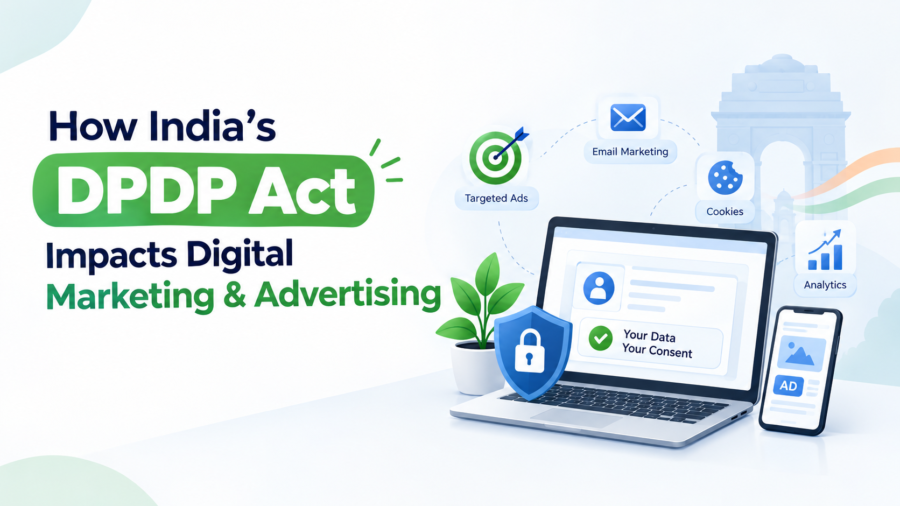
DPDP Act India: Impact on Digital Marketing & Advertising image

How India’s DPDP Act Impacts Digital Marketing and Advertising

Digital marketing in India has always depended heavily on data. Businesses collect names, phone numbers, email addresses, website visits, purchase history, customer preferences, and other information to reach the right people with the right message.

But the way businesses collect and use this information is changing.

India’s Digital Personal Data Protection Act, 2023 (DPDP Act) introduces a legal framework for handling digital personal data and gives individuals greater control over how their information is used. The government notified the DPDP Rules, 2025 in November 2025, with a phased implementation timeline.

For marketers, advertisers, website owners, and businesses, this means one important thing: customer data can no longer be treated simply as a marketing asset. It needs to be collected, used, protected, and managed responsibly.

What Is the DPDP Act in India?

The DPDP Act India framework focuses on the processing of digital personal data. In simple terms, if a business collects information that can identify a person, such as a name, mobile number, email address, or other personal information, the business needs to handle that data according to the applicable requirements.

The framework is built around concepts such as notice, consent, responsible processing, security, and individual rights.

The 2025 Rules add practical requirements around notices, consent management, security safeguards, and other compliance processes. The rules were notified on November 14, 2025, with different provisions coming into effect in stages.

This phased approach is particularly important in 2026 because businesses have time to review and improve their systems before all relevant requirements become applicable.

Why Does the DPDP Act Matter for Digital Marketing?

Modern marketing uses personal data at almost every stage.

A company may collect a visitor’s information through a website form, store leads in a CRM, send promotional emails, create advertising audiences, analyse customer behaviour, and use remarketing platforms.

For example, imagine a real estate company collecting a visitor’s name and phone number through a “Get Property Details” form. If that information is later used for promotional messages or other marketing purposes, the company needs to understand why it collected the data and how it intends to use it.

The DPDP framework encourages businesses to make these practices clearer rather than collecting information first and figuring out its purpose later.

Lead Generation Will Need Better Data Practices

Lead generation is one of the areas marketers should review carefully.

Many Indian businesses use forms such as:

Name + Phone Number + Email + Company Name + Requirement

The problem begins when a business asks for more information than it actually needs or uses the collected details for unrelated marketing activities.

A better approach is to clearly explain the purpose of the form.

For example:

“Submit your details to receive a free website consultation.”

This is easier for the customer to understand than a vague statement saying their information may be used for “business purposes.”

Marketing teams should also maintain proper records of how leads were collected and what communication permissions apply to them.

Email Marketing and Marketing Consent

Email marketing is another important area.

Suppose someone downloads an ebook from a company’s website. That does not automatically mean the business should treat the person’s email address as permission for every future marketing campaign.

Businesses should clearly communicate what the information is being collected for and design their consent process accordingly.

Marketing databases should also be regularly reviewed. If a person withdraws consent where consent is the basis for processing, businesses need a practical way to respond to that request.

The DPDP Act provides individuals with rights relating to their personal data and consent withdrawal, with the law stating that withdrawal should be as easy as giving consent.

Cookies and Website Tracking

Cookies are more complicated because not every cookie performs the same function.

A website may use cookies for basic functionality, analytics, advertising, personalisation, or other purposes. Some technologies can also be connected with information that identifies or relates to an individual.

This means website owners should understand what tracking technologies are installed on their websites instead of simply adding every available marketing script.

For example, a small Indian business may have Google Analytics, Meta Pixel, heatmap software, chat software, and several advertising scripts installed without knowing exactly what information each tool processes.

A proper website data review should identify these tools and document their purpose.

Importantly, the DPDP Act should not be treated as a simple “cookie banner law.” Businesses need to assess their actual data-processing activities and the requirements that apply to them.

Remarketing and Targeted Advertising

Remarketing has become a standard digital advertising strategy.

Someone visits an ecommerce website, looks at a pair of shoes, leaves without purchasing, and later sees advertisements for the same product. This is useful for advertisers because it can make campaigns more relevant.

However, targeted advertising increasingly depends on data and tracking technologies.

Marketers should therefore understand what data is being used to create advertising audiences and whether the relevant processing has an appropriate basis and required notices or consent.

This does not mean that all personalised advertising will disappear.

Instead, businesses need to become more disciplined about how customer data is collected and used for personalised marketing.

Customer Databases Need More Attention

Many businesses have years of customer information sitting inside spreadsheets, CRMs, email platforms, WhatsApp exports, or other systems.

The DPDP framework makes this a good time to ask basic questions:

  • Where did this customer data come from?
  • Why was it collected?
  • What is it currently being used for?
  • Who has access to it?
  • Which third-party platforms receive it?
  • Is old or unnecessary data still being stored?
  • How can a customer request action regarding their data?

For a small business with 5,000 customer records, even a simple data inventory can reveal information that is no longer necessary or properly organised.

Personalised Marketing Is Not Going Away

Personalisation remains valuable for digital advertising.

An ecommerce brand may recommend products based on previous purchases. A SaaS company may send different messages to free users and paying customers. A local business may personalise offers based on services a customer has shown interest in.

The DPDP framework does not simply mean “stop personalisation.”

Instead, businesses need to build personalisation around responsible data practices.

This can actually encourage marketers to focus more on first-party data—information collected directly through legitimate customer interactions—rather than relying heavily on unclear or unnecessary data sources.

Analytics and Measurement May Also Change

Digital marketers depend on analytics to measure traffic, conversions, campaigns, and customer journeys.

Businesses should review what personal information their analytics setup processes and whether every tracking tool is genuinely necessary.

A useful principle is simple:

Collect and process what you actually need for a clearly understood purpose.

For example, if a business only needs aggregate website traffic information to understand which blog posts perform well, it should consider whether collecting additional identifiable information through unnecessary tools adds real value.

What Should Indian Businesses Do Now?

Businesses do not need to wait until the final compliance deadlines to improve their marketing systems.

Here are some practical steps:

1. Create a Data Inventory

List the personal data your business collects through websites, forms, CRM systems, email platforms, advertising platforms, and other channels.

2. Review Your Forms

Check whether every field is necessary. Explain why information is being collected and avoid unnecessarily asking for personal details.

3. Audit Tracking Tools

Review analytics, pixels, cookies, chat tools, remarketing scripts, and other third-party technologies installed on your website.

4. Improve Consent Management

Make consent requests clear and understandable. Keep records where appropriate and create a straightforward process for handling withdrawal requests.

5. Clean Your Marketing Database

Remove unnecessary or outdated information according to your applicable retention and processing practices. Don’t keep customer data forever simply because storage is cheap.

6. Review Third-Party Platforms

Identify the advertising, CRM, email, analytics, and marketing automation platforms that receive or process customer data. Understand your responsibilities and contractual arrangements.

7. Train the Marketing Team

Data protection is not only an IT responsibility. SEO professionals, performance marketers, sales teams, web developers, and business owners may all interact with customer data.

What This Means for Marketing in 2026

For Indian businesses, 2026 is an important preparation period. The government has already notified the DPDP Rules, 2025 and established a phased timeline for implementation.

The practical lesson for marketers is simple: data-driven marketing needs better data discipline.

Businesses that understand what data they collect, why they collect it, where it goes, and how customers can exercise their rights will be better prepared for the changing privacy environment.

Conclusion

The DPDP Act and digital marketing are not necessarily in conflict. Good marketing still depends on understanding customers, measuring campaigns, and delivering relevant experiences. The difference is that businesses now need to pay much closer attention to the data behind those activities. For Indian businesses, the best time to review customer databases, website tracking, lead forms, email marketing, remarketing, and consent processes is before compliance becomes an urgent problem.

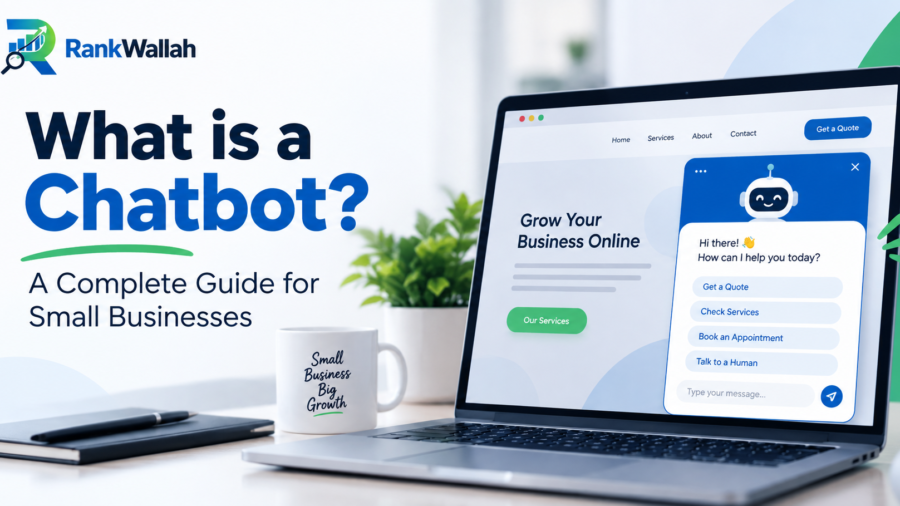
chatbot for small business

What is a Chatbot? A Complete Guide for Small Businesses

Remember when the only way to ask a business a question was to call them during office hours? Those days are mostly gone. Most people now check a website first, and if they don’t get an answer fast, they just move on to the next search result. That’s basically why chatbots exist now, and why so many small businesses are adding them.

This guide walks through what a chatbot really is, the different kinds you’ll run into, and how one might actually help your business, without the tech-speak.

What is a Chatbot, Really?

Put simply, a chatbot is a small program on your website that chats with visitors through a message window. It answers the questions people ask over and over, grabs a visitor’s contact details, and nudges them toward booking a service or getting a quote.

You can think of it a bit like a receptionist who never clocks out. It won’t handle every tricky situation the way a real person would, but it takes care of the routine stuff so your team isn’t stuck answering “what are your hours” for the tenth time that day.

The Main Types of Chatbots

Not every chatbot works the same way. Here’s a rundown of the three you’ll typically see.

Rule-Based Chatbots

These run on a fixed script. If someone types something the bot recognizes, like “book a cleaning,” it follows a set path, maybe asking for a date, then an address, then confirming.

A pest control company might use this kind of bot to show a simple menu: “Get a Quote,” “Schedule an Inspection,” “Emergency Service.” Click one, and you’re guided through a form.

They’re cheap and quick to set up. The catch is they fall apart the second a visitor asks something the script wasn’t written for.

AI-Powered Chatbots

This type uses natural language processing, which is just a fancy way of saying it tries to understand what someone means rather than matching exact words.

Say a shopper on an ecommerce site types “need something under 2000 for a birthday gift.” An AI bot picks up on the price limit and the occasion, and shows relevant products instead of just shrugging because the phrasing wasn’t exact.

These cost more to set up and take a bit of training, but they handle a much wider range of questions and tend to get better the more they’re used.

Hybrid Chatbots

Hybrid bots mix both. Rules handle the easy, high-volume stuff like hours or pricing, and the bot switches to AI or hands off to a human once things get complicated.

A healthcare clinic might use one this way: it instantly answers “what are your hours,” but the moment someone starts describing symptoms, it recognizes that this needs a real person and books a callback instead.

For most small businesses, this middle ground tends to work best.

Rule-Based vs AI-Powered, Side by Side

FeatureRule-Based ChatbotAI-Powered Chatbot
Setup costLowModerate to high
Handles unexpected questionsNoYes
Gets better over timeNoYes
Best forSimple, repetitive queries like hours or booking linksVaried questions, personalized suggestions
Setup timeFastSlower, needs training
MaintenanceManual script editsLess manual work once it’s trained

It’s Not Just About Answering Questions

A chatbot does more than field FAQs. If it’s set up well, it can quietly support your local SEO and conversions too, in ways that aren’t always obvious.

Dwell time. When someone actually chats with your bot instead of bouncing after ten seconds, they spend longer on the page. Search engines tend to read that as a sign the page is worth something.

Bounce rate. A visitor who gets a quick “yes, we service your area” is a lot less likely to leave right away. Fewer people leaving instantly is good for both the visitor’s experience and your rankings.

Capturing leads. Not everyone who lands on your site is ready to buy today. A chatbot can still grab their name, number, or email before they click away, which is a lead you’d otherwise have lost entirely.

Reviews. Some bots can prompt a happy customer to leave a Google review right after a good interaction. That directly helps your Google Business Profile and local visibility.

If you’re not sure how your site is doing on any of this right now, a full SEO audit is a decent place to start before layering a chatbot on top.

How This Plays Out by Industry

Kitchen & Bath Remodeling: A chatbot can qualify a lead before they even fill out a contact form, asking about project type, rough budget, and timeline. That way your sales team is calling back people who are actually serious, not everyone who clicked around the site once.

Pest Control: Same-day requests are pretty normal here. Letting a visitor pick their pest problem, drop in their address, and see an open slot right away removes a lot of the friction of waiting on a callback.

Cleaning Services: Repeat bookings keep this business running. A chatbot handling “can I reschedule my cleaning” or “what’s included in a deep clean” instantly takes a real load off the phones during busy hours.

Why Businesses Bother With This

It never sleeps. Your bot is working nights, weekends, holidays, catching the leads that would otherwise go to whichever competitor answered faster.

Answers come quicker. People get a response in seconds instead of waiting on a callback, and that matters a lot when they’re comparing you to two other businesses at the same time.

Less pressure on your team. The repetitive stuff, pricing, hours, service area, gets handled on autopilot, so your staff can focus on calls that actually need a human.

Better sense of who’s serious. A few upfront questions help you tell the difference between someone ready to book and someone just browsing.

Same answer every time. A busy staff member juggling calls might give slightly different answers depending on the day. A bot doesn’t have that problem.

Useful data. What people ask your chatbot tells you a lot, and that’s genuinely useful when you’re rewriting service pages or FAQs later.

Picking the Right One for Your Site

Before you commit to a tool, run through this:

  • Match it to how many questions you actually get. A handful of repeat questions a day? Rule-based is fine. Varied, detailed questions? Go AI or hybrid.
  • Check it connects to your booking or CRM setup. Leads should flow straight into whatever system you already use, not create more manual work.
  • Make sure a human handoff exists. There should always be a way for someone to reach a real person if the bot can’t help.
  • Try it on your phone. Most local traffic comes from mobile, so the chat window needs to actually work on a small screen.
  • Look at the full cost, not just the price tag. Factor in the time it takes to write scripts or train the AI, not just the subscription fee.
  • Don’t overbuild on day one. Launch with the basics, see what the conversations look like after a month, then expand from there.

Wrapping Up

A chatbot won’t replace your team, but it does make sure nobody leaves your site empty-handed without at least getting a quick answer. In a competitive local market, that alone can be the difference between winning a lead and losing it to whoever’s website responded faster.

If you’re thinking about pairing a chatbot with a stronger local SEO push, or your site needs a rebuild to support tools like this properly, RankWallah’s website development and local SEO services can help. Get in touch to see where things stand right now.

Google My Business SEO image

Google My Business SEO: How to Improve Your Local Business Visibility

Google My Business SEO is the process of optimizing your Google Business Profile (GBP) so your business can appear more prominently in Google Search and Google Maps. Although Google My Business is now officially called Google Business Profile, the older term remains widely used by businesses searching for local SEO services. A well-optimized profile helps potential customers discover your business, understand what you offer, check reviews, and take actions such as calling or visiting your website.

What Is Google My Business SEO?

Google My Business SEO focuses on improving the information, relevance, and overall quality of your Business Profile. It is an important part of local search optimization, particularly for businesses that serve customers in a specific city or service area.

Effective seo for google my business typically involves:

  • Choosing the most relevant primary and secondary categories
  • Keeping business information accurate and complete
  • Adding services, products, photos, and business descriptions
  • Collecting and responding to genuine customer reviews
  • Maintaining consistent name, address, and phone information
  • Keeping the profile updated with relevant posts and information

The objective is to provide Google and potential customers with clear, accurate information about your business.

Why Google My Business SEO Matters for Local Businesses

When someone searches for a nearby service, Google may display local businesses through the local pack and Maps results. A complete and relevant Business Profile can make it easier for customers to discover your company when they are actively looking for the products or services you provide.

For Indian businesses, this can be particularly useful for location-based searches such as restaurants, clinics, salons, agencies, repair services, retailers, and professional services.

However, profile optimization alone does not guarantee a specific ranking. Google considers several signals when determining local results, including relevance, distance, and prominence.

How to Optimize Your Google Business Profile

A practical local seo google my business strategy should start with the basics and then build stronger local relevance.

1. Complete your profile:
Provide accurate business details, including your name, address or service area, phone number, website, operating hours, categories, and services.

2. Select relevant categories:
Your primary category should closely represent your main business. Additional categories can describe other important services where appropriate.

3. Add quality photos:
Upload genuine, recent images of your location, team, products, services, or completed work. Visual content can help customers understand your business before contacting you.

4. Build genuine reviews:
Encourage real customers to leave honest reviews. Respond professionally to both positive and negative feedback instead of using repetitive responses.

5. Keep information updated:
Update holiday hours, services, photos, products, and other relevant information whenever something changes.

6. Strengthen your website:
Your website should support your Business Profile with location-specific content, consistent business information, relevant service pages, and useful local information.

Common Google My Business SEO Mistakes to Avoid

Some businesses create a profile and then rarely maintain it. Other common mistakes include selecting irrelevant categories, using inaccurate business information, adding keyword-stuffed business names, ignoring reviews, or publishing low-quality content.

Avoid tactics designed only to manipulate rankings. Good seo google my business practices should prioritize accurate information and a useful customer experience.

How Local SEO and Google Business Profile Work Together

Google Business Profile optimization works best as part of a broader local SEO strategy. Your website, business directories, reviews, local content, backlinks, and location signals can all contribute to your overall online presence.

For example, an Indian business targeting customers in Delhi, Mumbai, Bengaluru, or another city can create relevant service and location pages while keeping its Business Profile and other business information consistent.

Conclusion

Google My Business SEO helps businesses present accurate, relevant information to both Google and potential customers. For businesses targeting local customers in India, optimizing the Google Business Profile alongside a strong local SEO strategy can create a more consistent and discoverable online presence. The focus should always be on providing useful information, earning genuine reviews, and maintaining an accurate profile rather than trying to manipulate rankings.

ChatGPT Ads in India image

ChatGPT Ads in India: What They Mean for Users, Businesses & SEO in 2026

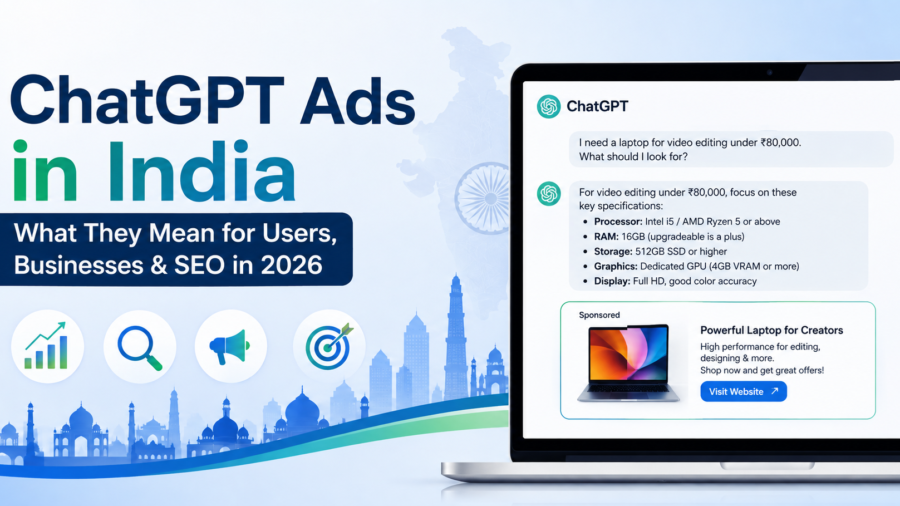
If you use ChatGPT on the Free or Go plan in India, you may have noticed something new: ads are starting to appear below some ChatGPT responses.

OpenAI began rolling out its advertising programme in India on August 27, 2026, making India one of the latest markets to get ChatGPT Ads. The initial rollout is aimed at logged-in adult users on the Free and Go plans, while Plus, Pro, Business, Enterprise and Edu remain ad-free. More than 50 brands are part of the initial Indian rollout, with WPP and Omnicom among the first agency partners.

For ordinary users, this raises an obvious question: Will these ads change the answers ChatGPT gives?

For businesses and SEO professionals, there is another question: Does this create a new advertising channel that could change how people discover brands online?

The answer to both is worth understanding before drawing conclusions.

ChatGPT Ads Have Arrived in India

The Indian rollout officially began on August 27, 2026.

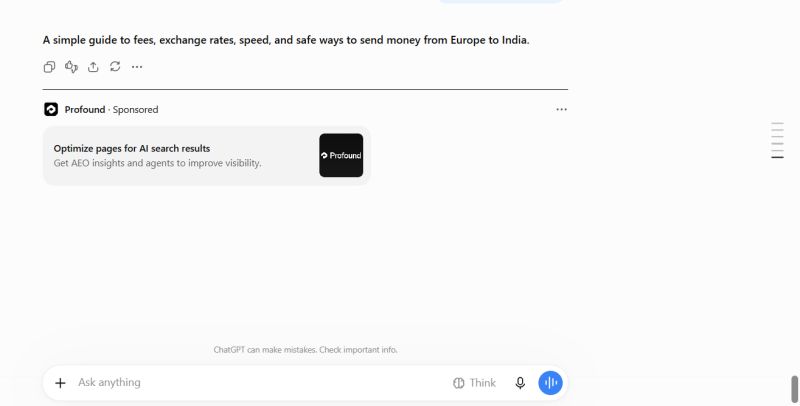
OpenAI says ads may appear to eligible users when there is a relevant advertising opportunity. They are displayed separately from the normal ChatGPT response and are clearly marked as sponsored.

The rollout follows several months of testing in other markets. OpenAI first began testing ads with Free and Go users in the US in February 2026 and subsequently expanded the programme to additional countries.

India is particularly significant because ChatGPT has a very large user base here. TechCrunch reported that OpenAI said India had more than 100 million weekly active ChatGPT users earlier in 2026.

That makes India an important market not only for ChatGPT itself, but also for advertisers trying to reach people while they are researching products, services and ideas.

What Are ChatGPT Ads?

ChatGPT Ads are paid promotional placements that can appear below a ChatGPT response.

They are different from the text ChatGPT generates for the user. OpenAI says the advertising system operates separately from the system generating ChatGPT’s answers. Ads are also visually separated and labelled as sponsored.

Think about a simple example.

You ask:

“I need a laptop for video editing under ₹80,000. What specifications should I look for?”

ChatGPT might provide an ordinary answer explaining processors, RAM, storage, display and graphics requirements.

If there is a relevant advertisement, a sponsored placement may appear below that answer.

That is different from a traditional Google Search ad, where advertisements can appear above or below search results. It is also different from a social media ad, where the platform generally decides what appears in your feed.

ChatGPT’s advertising model is built around the context of a conversation.

OpenAI says its ad system can consider the current conversation’s context and intent, along with information supplied by advertisers about where their products or services may be relevant.

Who Will See Ads on ChatGPT in India?

For the current programme, ads are aimed at logged-in adult users on the Free and Go plans.

OpenAI says Plus, Pro, Business, Enterprise and Edu accounts do not have ads. It also says ads are not shown to accounts identified as belonging to people under 18.

ChatGPT Plan

Ads

Free

May see ads

Go

May see ads

Plus

No ads

Pro

No ads

Business

No ads

Enterprise

No ads

Edu

No ads

There is also an important distinction for Free users. OpenAI currently provides an Ads-Free option for eligible Free users, although switching to it means accepting lower usage limits and reduced access to some features.

So seeing an advertisement does not mean every ChatGPT user in India will see the same advertising experience.

Where Do ChatGPT Ads Appear?

The most important thing to understand is the placement.

ChatGPT Ads appear below the ChatGPT response, rather than being inserted into the answer itself. OpenAI says advertisements are clearly labelled as sponsored and visually separated from the response.

An ad can include:

  • Advertiser name

  • Logo or favicon

  • Headline

  • Description

  • Image

  • Landing page

The advertising system decides whether an eligible advertisement is relevant to the conversation.

This is an important difference from simply showing a random banner.

For example, someone discussing home renovation could potentially encounter an advertisement related to flooring, furniture, renovation services or another relevant product.

That does not mean the advertiser has paid to become part of ChatGPT’s answer.

Do ChatGPT Ads Change the Answers You Get?

No. OpenAI says advertisers cannot change, rank or alter ChatGPT’s answers.

This is one of the most important principles behind the advertising programme.

OpenAI says ads operate separately from the chat model and do not influence the answers users receive. Seeing an advertisement also does not mean that OpenAI recommends or endorses the advertiser.

So there is a clear distinction:

ChatGPT answer: generated independently based on the conversation.

Advertisement: paid placement displayed separately below the response.

That distinction matters because users are likely to use ChatGPT for product research and recommendations. If paid placements could directly change answers, the line between advertising and organic information would become much harder to understand.

OpenAI has therefore made answer independence one of its stated advertising principles.

Can Advertisers See Your ChatGPT Conversations?

No. Advertisers do not receive your ChatGPT conversations, chat history or memories.

OpenAI says advertisers receive aggregated campaign information such as views and clicks rather than the contents of individual conversations. It also says advertisers do not receive users’ names, email addresses, precise locations, IP addresses or sensitive information.

There is, however, an important distinction between using conversation context to select an advertisement and giving that conversation to the advertiser.

OpenAI says information used to make ads relevant stays within ChatGPT. Depending on the user’s settings, this can include the current conversation and, where ad personalization is enabled, certain signals from past chats and memory.

In simple terms:

ChatGPT can use relevant signals to decide which ad may fit. The advertiser does not get to read your chat.

Users also have controls over ad personalization and can manage their advertising settings.

How ChatGPT Ads Could Change Online Advertising in India

This is where things become interesting for marketers.

Traditional search advertising is largely built around search queries and keywords.

For example:

“best running shoes under ₹5,000”

A user has entered a specific search.

A conversational platform can receive something much more detailed:

“I run five days a week, mostly on roads, and have a budget of ₹5,000. I want something comfortable that will last.”

The second interaction contains more context.

It tells a business more about what the person is trying to accomplish.

OpenAI’s current advertising system uses conversation context and intent as part of ad selection. Advertisers can also provide context hints describing the conversations, topics or keywords where their products may be relevant. OpenAI says these hints help guide matching but are not exact-match keywords and do not guarantee delivery.

That creates an interesting advertising environment.

Instead of thinking only about:

“Which keyword should I bid on?”

advertisers may increasingly need to think about:

“In what kind of conversation would my product actually be useful?”

That is a meaningful change in how marketers can think about paid discovery.

What ChatGPT Ads Mean for Indian Businesses

ChatGPT Free have ads in India image

The opportunity will not look identical for every business.

A large e-commerce company may have thousands of products and strong landing pages. A SaaS company may want to reach people researching software. A travel company could be relevant when someone is planning a trip.

Some sectors that could potentially benefit include:

  • E-commerce

  • SaaS

  • Travel

  • Retail

  • Education

  • Financial services

  • Health and beauty

  • Consumer brands

  • Local businesses

  • Startups

But businesses should not assume that simply advertising on ChatGPT will produce results.

The basics still matter.

If someone clicks an advertisement and reaches a slow website with unclear pricing, poor mobile usability or weak product information, the advertising platform cannot solve that problem.

The same principle applies to SEO.

Getting the click is only one part of the journey.

The website still needs to convince the visitor.

What about smaller Indian businesses?

This is particularly interesting because OpenAI is introducing self-service advertising access in India.

According to reporting on the launch, ChatGPT Ads Manager is scheduled to become available to Indian businesses from September 4, 2026, with reported minimum daily campaign budgets starting at ₹725.

That makes the platform potentially accessible beyond large brands and major advertising agencies.

However, a ₹725 minimum does not mean ₹725 will guarantee traffic, leads or sales. It is simply a starting campaign budget reported for the self-service platform.

Businesses should judge the channel based on actual performance.

What ChatGPT Ads Mean for SEO

For SEO professionals, this is probably the most important part of the discussion.

ChatGPT Ads do not replace SEO.

Paid advertising and organic search visibility are different things.

SEO focuses on earning visibility through useful content, technical quality, relevance, authority, links, structured information and a strong overall website experience.

Advertising buys a promotional opportunity.

The two can work alongside each other.

Imagine a company selling accounting software in India.

Its SEO strategy might target searches such as:

  • accounting software for small businesses

  • GST accounting software

  • bookkeeping software

  • best accounting software for startups

Its content can answer those questions and build organic visibility over time.

Advertising, meanwhile, can provide paid exposure to people who are actively researching software.

The smart strategy is not:

SEO or ChatGPT Ads.

It is understanding where each channel fits.

SEO vs ChatGPT Ads: What’s the Difference?

Factor

SEO

ChatGPT Ads

Main purpose

Earn organic visibility

Buy promotional visibility

Cost

Investment in content, technology and resources

Paid advertising budget

Visibility

Earned

Paid

User intent

Search-based and informational/commercial

Conversational and contextual

Control

Limited control over rankings

Greater control over campaign settings

Long-term value

Can continue generating traffic after content ranks

Depends on ongoing ad spend

Measurement

Rankings, clicks, traffic, leads, conversions

Impressions, clicks, CPC, CTR, conversions and other campaign metrics

Best use

Building sustainable organic visibility

Reaching relevant users during active research

OpenAI’s Ads Manager documentation currently lists CPM and CPC buying options, along with reporting for impressions, clicks, spend, CTR, average CPC, average CPM and conversions.

The important point for businesses is that these are different marketing channels, not two versions of the same thing.

Will ChatGPT Ads Replace Google Ads?

Probably not.

At least, there is no reason to treat the arrival of ChatGPT Ads as the end of Google Ads.

Google Search and ChatGPT serve different user experiences.

Someone searching Google may want a list of websites, products, maps, reviews or direct search results.

Someone using ChatGPT may want a conversation that helps them compare options, understand a problem or make a decision.

There will certainly be overlap.

A person could discover a brand through Google, see it on Instagram, compare it on Amazon and later ask ChatGPT whether it is a good option.

That means the advertising market may become more spread out rather than simply moving from one platform to another.

For marketers, this means understanding where customers make decisions becomes increasingly important.

Should Indian Businesses Start Preparing for ChatGPT Advertising?

Yes, but preparation does not necessarily mean immediately spending money.

There are several things businesses can do first.

1. Understand customer questions

Look beyond traditional keywords.

Find the questions people ask before buying your product or hiring your service.

2. Improve your website content

Make product and service information easy to understand.

Pricing, features, benefits, comparisons, policies and FAQs should not be hidden behind confusing navigation.

3. Strengthen landing pages

A paid click has value only when the landing page gives the visitor a good reason to continue.

4. Build brand trust

Reviews, testimonials, transparent business information and useful content can all help when someone is deciding between alternatives.

5. Track traffic properly

Use analytics and UTM parameters so you can distinguish paid ChatGPT traffic from other sources.

OpenAI’s advertising documentation says static tracking parameters such as UTM parameters can be added to landing page URLs.

6. Think about conversational intent

Instead of only asking which keyword has the highest search volume, ask what problem the customer is trying to solve.

7. Keep product and service information clear

If your website contains incomplete or confusing information, every discovery channel becomes harder to convert.

8. Watch the platform before scaling

The Indian advertising programme is still relatively new.

Businesses should test carefully, measure results and scale based on performance rather than excitement around a new platform.

What Marketers Should Watch in 2026

The most interesting part of ChatGPT advertising is that the platform is still being developed.

Marketers should keep an eye on:

  • Availability of ChatGPT Ads in different countries

  • Self-service Ads Manager features

  • Campaign objectives

  • CPC and CPM pricing

  • Conversion tracking

  • Measurement options

  • Audience controls

  • Advertiser adoption

  • User response to sponsored content

  • Changes in conversational search behaviour

OpenAI has already expanded its advertising tools during 2026, including CPC bidding, self-service campaign creation and additional measurement capabilities.

That suggests the advertising product is not finished yet.

For Indian marketers, the better approach is to watch how the channel performs rather than assuming it will automatically become the next major source of customers

Frequently Asked Questions

Yes. OpenAI began rolling out ChatGPT Ads in India on August 27, 2026. Ads are currently aimed at logged-in adult users on the Free and Go plans, while Plus, Pro, Business, Enterprise and Edu remain ad-free.

Eligible logged-in adult users on the Free and Go plans may see advertisements. OpenAI says users on Plus, Pro, Business, Enterprise and Edu do not see ads, and accounts identified as belonging to people under 18 are excluded.

Yes, eligible Free users may see ads. OpenAI also provides an Ads-Free option for eligible Free users, but using it comes with lower usage limits and reduced access to some features.

Hostinger Review 2026

Hostinger Review 2026: Still the Best Budget Host?

If you’re launching a new site or switching from an overpriced host, Hostinger is probably the name you keep hearing. It’s grown from a free web hosting service into one of the most recognized names in the industry, and we spent time testing it across shared, cloud, and VPS tiers to see if it still holds up in 2026.

One-line verdict: A top value pick for beginners, growing businesses, and budget-conscious site owners who want speed, reliability, and genuine ease of use without a steep learning curve.

Fast, Consistent Load Times

Page speed directly affects whether visitors stick around, and Hostinger delivers here. Across our shared hosting tests, average load times landed around 480-520ms noticeably faster than most Apache-based budget hosts. This comes down to Hostinger’s use of LiteSpeed web servers instead of the older Apache stack most competitors rely on. LiteSpeed also uses aggressive caching to serve repeat visitors even faster, which matters a lot for content-heavy sites and online stores.

Strong, Dependable Uptime

Shared and WordPress hosting plans hovered around 99.9%+ uptime over our monitoring period, and VPS tiers performed even more consistently with fewer interruptions. For most small-to-mid-sized websites, that level of reliability is more than enough to keep search rankings and customer trust intact.

Genuinely Great Value

What stands out about Hostinger isn’t just that it’s cheap it’s that the entry-level plans don’t feel stripped down. Even at the lowest tier, you get free SSL certificates, automated backups, and malware scanning bundled in, which many competitors reserve for higher-priced plans. Add in a free domain for the first year on annual terms (often with WHOIS privacy protection included), and the overall package feels far more generous than the price tag suggests.

An Interface Beginners Actually Enjoy

Hostinger built its own custom control panel, hPanel, instead of licensing the industry-standard cPanel and it shows. Everything is laid out logically, the setup wizard walks new users through the essentials, and you won’t need a tutorial just to find where your files or databases live. For anyone setting up their first website, this alone removes a huge amount of friction.

One-Click Installs for Everything

Installing WordPress, WooCommerce, Drupal, or PrestaShop takes a single click through Hostinger’s Auto Installer. There’s no manual database creation, no fiddling with config files just pick your app and it’s ready to go in minutes. This is especially valuable for non-developers who want to get a functional site live without touching code.

Hassle-Free Migrations

Switching hosts is often the biggest reason people avoid leaving a bad provider. Hostinger removes that friction with a free migration service you submit a request with a few details, and their team handles the technical transfer. WordPress migrations are largely automated and typically complete within 24-48 hours, meaning minimal downtime for your live site.

AI-Powered Website Builder

Every Hostinger plan includes a capable website builder with over 100 templates, plus an AI-assisted setup that can generate a customized site in minutes. It’s a strong option for anyone who wants a professional-looking site whether a portfolio, a service business page, or a full ecommerce store without hiring a designer or learning a page builder from scratch.

Global Infrastructure

Hostinger operates data centers across North America, South America, Europe, and Asia, including locations in the US, UK, Germany, India, Singapore, and Brazil. This lets you choose a server location close to your target audience, reducing latency. Business-tier plans and above also include CDN access, which further speeds up load times for visitors regardless of where they’re browsing from.

Support That Actually Helps

While Hostinger doesn’t offer phone support, its 24/7 live chat and ticket system consistently deliver clear, detailed answers. In our interactions, reps went as far as providing annotated screenshots to walk through exact steps a level of hand-holding that’s rare from a budget host.

Why Every Local Business Needs a Professional Website in 2026

Why Every Local Business Needs a Professional Website in 2026

In 2026, customers in India are searching online before choosing a local business. Whether they need a doctor, coaching centre, property dealer, restaurant, salon, manufacturer, or service provider, Google is often the first place they look. This makes having a professional website for a local business more important than ever.

For businesses in cities like Ghaziabad and Bareilly, a well-designed website can help build trust, improve online visibility, generate enquiries, and turn local searches into potential customers.

1. Customers Are Searching Online

The way people find local businesses has changed significantly. Instead of asking friends or visiting multiple shops, customers can search for services online within seconds.

For example, someone in Ghaziabad may search for:

  • Best dentist in Ghaziabad
  • Website designer in Ghaziabad
  • Coaching centre near me
  • Property dealer in Ghaziabad

Similarly, customers in Bareilly may search for local restaurants, doctors, educational institutes, retailers, or professional services.

If your business does not have a professional online presence, potential customers may discover your competitors instead.

2. A Website Builds Trust

A professional website can make a local business look more credible and established.

Customers can visit your website to learn about your company, services, experience, customer reviews, location, and contact details. This information helps them understand your business before making a decision.

For example, a customer looking for a service provider in Ghaziabad may compare several businesses online. A clear and professional website can help your business make a stronger first impression.

Your website should communicate three things quickly:

What you offer, where you operate, and why customers should choose you.

3. Your Website Supports Local SEO

Having a website is also important for Local SEO.

Local SEO helps businesses become more visible when people search for products or services in a specific location. A properly optimized website can target relevant searches such as “service provider in Ghaziabad” or “business services in Bareilly.”

Important website elements for local SEO include:

  • Location-focused content
  • Optimized page titles and descriptions
  • Service pages
  • Internal linking
  • Mobile-friendly design
  • Fast loading speed
  • Relevant local information
  • Clear contact details

When combined with a properly optimized Google Business Profile, your website can become an important part of your local search strategy.

4. A Website Can Generate Leads 24/7

Your physical business may have fixed working hours, but your website can work around the clock.

A potential customer can visit your website at any time, understand your services, and contact you through a call, WhatsApp button, enquiry form, or email.

For example, a coaching centre in Bareilly could use a “Book a Free Counselling Session” button, while a property dealer in Ghaziabad could use “Talk to a Property Expert.”

Clear calls to action can turn website visitors into genuine enquiries.

5. Social Media Is Not a Replacement for a Website

Instagram, Facebook, and WhatsApp are valuable marketing channels, but they should not be your entire online presence.

Social media helps businesses engage with customers and build awareness. A website provides a central place where customers can find complete information about your business.

Think of it this way:

Social media helps people discover your business.

Your website helps them understand, trust, and contact your business.

Using both together can create a stronger digital presence.

6. A Professional Website Helps You Compete Locally

Small businesses don’t always need to compete with national brands. They can focus on attracting customers in their own service areas.

A salon can target customers in Ghaziabad. A coaching institute can focus on students in Bareilly. A local manufacturer can target buyers across nearby cities.

A website allows businesses to create dedicated service and location content that speaks directly to their target customers.

Conclusion

In 2026, a professional website is more than an online visiting card. For local businesses in Ghaziabad, Bareilly, and other Indian cities, it can support branding, Local SEO, customer trust, and lead generation.

Whether you run a clinic, coaching centre, restaurant, salon, property business, manufacturing company, or professional service, your website should make it easy for customers to find you, understand your services, trust your business, and take action.

A well-planned website can become the foundation of your digital marketing strategy and help your local business grow in an increasingly competitive Indian market.

Helping Ghaziabad businesses grow through strategic social media marketing and advertising.

Social Media Marketing Agency in Ghaziabad for Real Business Growth

Every business in Ghaziabad has a story worth telling — but only a few are telling it where it matters most. If your brand is not visible on social media today, your competitors are already taking that space. That is why partnering with the right social media marketing agency in Ghaziabad can be one of the smartest decisions you make for your business this year.

We are a Ghaziabad-based digital marketing agency helping local businesses, clinics, hospitals, and growing brands build a strong, credible presence across social media platforms. Our work is rooted in strategy, creativity, and real results — not just likes and followers.

What is a Social Media Marketing Agency?

A social media marketing agency is a team of specialists who manage your brand’s entire social presence. They plan content, design visuals, run paid advertisements, engage with your audience, and track what is working — all on your behalf.

Think of it as having a full-time marketing team without the overhead cost of hiring one in-house. You get expert execution, consistent output, and measurable growth.

Why Your Business Needs Social Media Marketing

India has over 700 million active internet users, and a large majority of them are scrolling through Instagram, Facebook, and LinkedIn every single day. Your potential customers are already there — the question is whether they can find you.

Social media marketing services in Ghaziabad help businesses do three things consistently:

  • Get discovered by the right audience at the right time
  • Build trust through valuable and engaging content
  • Turn that trust into real inquiries, walk-ins, and sales

Whether you run a medical clinic in Indirapuram, a retail shop in Vaishali, or a manufacturing firm in the industrial belt — a well-executed social media strategy delivers results across the board.

Benefits of Hiring a Social Media Marketing Agency in Ghaziabad

Choosing a local social media agency in Ghaziabad gives your business a meaningful edge. A local team understands the culture, the local customer mindset, the seasonal buying patterns, and the kind of content that resonates with people in this region.

Here is what you gain when you work with a professional agency:

  • Brand Awareness — Your business becomes recognisable and memorable to the right audience across Ghaziabad and the wider Delhi NCR market.
  • Lead Generation — Strategic content and paid campaigns attract people who are already looking for what you offer.
  • Content Creation — Original graphics, videos, and copy that reflect your brand’s personality and values.
  • Social Media Management — Consistent posting schedules, timely replies, and active community management.
  • Social Media Advertising — Targeted ad campaigns on Facebook and Instagram that maximise every rupee of your budget.

Social Media Platforms We Manage

Different platforms serve different business goals. We make sure your brand is active on the platforms where your audience actually spends time.

Instagram Marketing

Instagram is built for visual storytelling. Reels, Carousels, and Stories create deep engagement for businesses in healthcare, food, fashion, real estate, and retail. We create content that stops the scroll and starts a conversation.

Facebook Marketing

Facebook remains the most powerful platform for reaching a broad, diverse audience. We use it to run highly targeted social media advertising campaigns — narrowing your audience by location, age, profession, and interest — so your budget goes to the people most likely to become your customers.

LinkedIn Marketing

For clinics, hospitals, educational institutions, and B2B businesses, LinkedIn builds credibility fast. We help you share thought leadership content, connect with the right professionals, and generate high-quality leads through organic and paid strategies.

We also manage YouTube Shorts, WhatsApp Business Broadcasts, and Google Business Profile posts as part of a complete digital presence strategy.

Our Social Media Marketing Services

Our social media marketing services in Ghaziabad are designed to cover every stage of your brand’s online journey:

  • Content Creation — Platform-specific graphics, short videos, reels, and copywriting crafted for your target audience
  • Social Media Management — Regular posting, comment responses, DM handling, and brand reputation monitoring
  • Paid Social Advertising — Facebook Ads, Instagram Ads, and LinkedIn Ads with clear performance benchmarks
  • Competitor Analysis — We study what your local competitors are doing so we can do it better
  • Monthly Reporting — Simple, transparent reports showing exactly what was done and what results it delivered

Every service is tied directly to a business outcome — not just surface-level activity.

Industries We Serve

We have hands-on experience working with businesses across key industries in Ghaziabad and the Delhi NCR region:

  • Healthcare — Hospitals, clinics, dental practices, diagnostic centres, and specialist doctors
  • Real Estate — Builders, housing societies, brokers, and interior design firms
  • Education — Schools, coaching institutes, skill development centres, and ed-tech startups
  • Retail and E-commerce — Local shops and online stores targeting Tier 1 and Tier 2 customers
  • Food and Hospitality — Restaurants, cafes, tiffin services, and cloud kitchens
  • Manufacturing and B2B — Industrial and product-based businesses building brand credibility

No matter your sector, social media has a role to play in your growth.

Our Social Media Marketing Process

We follow a structured process that ensures your investment always moves toward real business results:

  1. Discovery Call — We learn about your business, your goals, your target audience, and your current social presence
  2. Custom Strategy — We build a content plan and advertising strategy specific to your industry and location
  3. Content Production — Our creative team designs and writes all content before it goes live
  4. Publishing and Engagement — We post consistently and actively manage your community
  5. Performance Review — Every month, we analyse results, share a clear report, and refine the strategy

This is not a one-size-fits-all approach. Every client gets a plan built specifically for their business.

Why Choose Our Agency

There are many agencies offering digital marketing services in Ghaziabad, but here is what makes our approach different:

  • We are a local team with deep knowledge of the Ghaziabad and Delhi NCR market
  • We have worked extensively with healthcare and local service businesses — industries that require sensitivity and precision in communication
  • We create 100% original content — no stock templates, no recycled posts
  • We focus on business outcomes — leads, calls, footfall, and sales — not just engagement numbers
  • Every client gets a dedicated point of contact who understands their account inside and out

We believe social media should work as hard as you do.

Common Mistakes Businesses Make on Social Media

Many Ghaziabad businesses try to handle social media themselves and end up making costly errors:

  • Posting inconsistently, which trains the algorithm to deprioritise your content
  • Using low-quality images and videos that make the brand look unprofessional
  • Ignoring comments, messages, and reviews from potential customers
  • Running ads without a clear targeting strategy — spending money with nothing to show for it
  • Copying competitor content instead of building a unique brand voice

A professional team eliminates all of these problems from the very beginning.

Tips to Improve Social Media Performance

Whether you are just starting out or already active on social platforms, these practical steps can improve your results:

  • Post at least 4 to 5 times per week to stay consistent and visible
  • Use local hashtags like #Ghaziabad, #DelhiNCR, and industry-specific tags to increase reach
  • Reply to every comment and message within 24 hours — responsiveness builds trust
  • Invest in short-form video content — Reels and YouTube Shorts consistently outperform static posts
  • Review your analytics every month and focus more on what your audience responds to best

Consistency and clarity will always outperform random bursts of activity.

Conclusion

Ghaziabad’s business landscape is competitive and growing fast. Businesses that invest in a strong social media presence today are the ones that will lead their categories tomorrow. Whether you need Instagram marketing, Facebook advertising, LinkedIn lead generation, or complete social media management — we have the expertise and the local knowledge to deliver it.

If you are serious about growing your brand online, do not wait. Reach out to our team today for a free social media audit, and let us build a strategy that drives real results for your business in Ghaziabad.

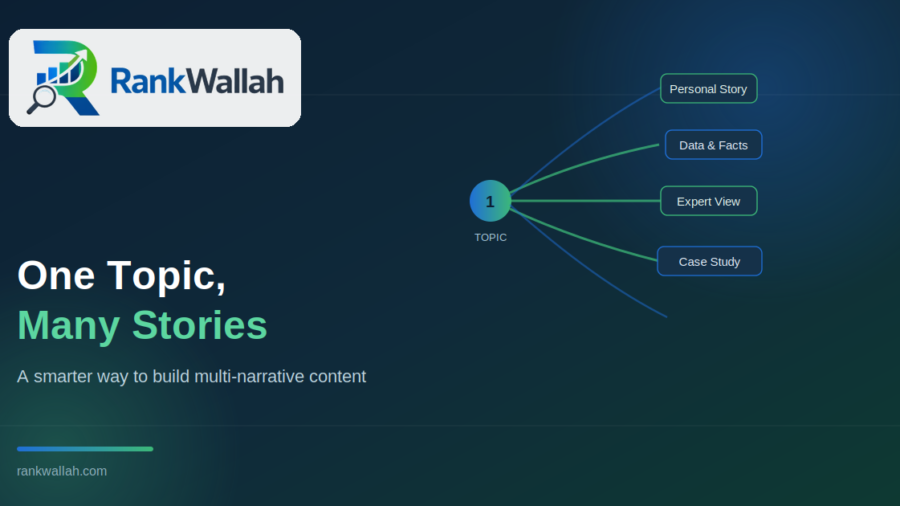
One topic many stories multi-narrative content strategy diagram - RankWallah

One Topic, Many Stories: Why Smart Creators Stop Writing the Same Article Twice

Most content calendars are built like a checklist. Pick a topic, write the post, check it off, move to the next topic. It’s efficient — and it’s also why so much content feels forgettable. The fix isn’t writing more topics. It’s writing more stories about the same one.

Think about how a good documentary series works. It doesn’t explain its subject once and stop. It returns to the same subject from a dozen directions — an interview here, an archival clip there, a personal account, a data point, a counterargument — and by the end you understand the subject in a way no single 20-minute segment could have delivered. That’s the model worth stealing for content strategy: treat your topic less like a single article and more like a subject you’re allowed to revisit, again and again, from a different angle each time.

Why One Angle Isn’t Enough Anymore

A topic rarely has just one audience. Take something as ordinary as “freelancing.” A beginner wants reassurance and a starting checklist. A five-year veteran wants tax strategy and burnout management. A client hiring freelancers wants to know how to vet one. All three are interested in the same broad subject, but a single article can’t serve all of them without becoming shallow for everyone.

This is also, increasingly, how search engines read authority. A site that publishes one isolated post about freelancing looks like it dabbled in the topic. A site that’s published a beginner’s guide, a deep-dive on freelance taxes, a client-side hiring guide, and a few personal case studies looks like it actually knows the subject — and search algorithms reward that depth with better rankings, not just better reader satisfaction.

There’s a human reason too. Data convinces the analytical mind, but it rarely moves anyone emotionally. A personal story does the opposite — it sticks, but it doesn’t always carry weight or evidence on its own. When you tell a topic through multiple stories, you can give one piece to the head and another to the heart, instead of forcing a single article to awkwardly do both jobs at once.

A Worked Example

Say your subject is “the four-day workweek.” Instead of one explainer post, you could build:

  • The skeptic’s story — a mid-size company that tried it, struggled with client expectations, and rolled it back. Honest, not promotional.
  • The convert’s story — a team that redesigned its meetings and workflows and now genuinely produces more in four days than five.
  • The numbers story — what the pilot studies actually show, stripped of hype, with the caveats nobody puts in the headline.
  • The manager’s story — practical advice for someone trying to propose this to leadership without sounding naive.

Each piece stands on its own. Together, they cover doubt, success, evidence, and execution — the four things any reader actually needs before they can form a real opinion on the topic.

A Simple Framework to Build This Yourself

1. Pick a topic with enough surface area. Not every subject supports multiple stories. “How to reset a router” doesn’t. “Return to office policies” does, because it touches employees, managers, real estate costs, and culture all at once. Look for topics where reasonable people disagree, or where different groups experience the same event differently.

2. List who actually cares, and why they care differently. Don’t brainstorm angles in the abstract — brainstorm audiences first. A parent, a teacher, and a policymaker can all care about “screen time,” but their stakes and questions barely overlap.

3. Match each angle to its natural format. A personal story usually wants narrative prose. A skeptical or technical angle wants data and structure. A practical angle wants a checklist or steps. Don’t force every angle into the same template just because it’s convenient.

4. Build the connective tissue before you publish. This is the step people skip. If your four stories don’t link to each other and don’t share a recognizable thread — a consistent framing, a recurring visual, a one-line reminder of the bigger theme — they’ll just read as four unrelated posts that happen to share a tag. The cluster only works if a reader can feel the seams connecting them.

5. Stagger the release. Publishing all four pieces in one day buries them in your own feed. Spacing them out gives each story its own moment, and gives you something to link back to as you go.

Where This Goes Wrong

The most common failure isn’t lack of ideas — it’s redundancy disguised as variety. Four stories that all say the same thing in slightly different tones aren’t four stories; they’re one story with four headlines. Before publishing, ask honestly: if someone read only one of these, would they walk away thinking something genuinely different than if they’d read another? If the answer is no, merge them or rethink the angles.

The second failure is one-sidedness. If every “different perspective” happens to support the same conclusion, you haven’t built a multi-narrative piece — you’ve built one argument wearing several disguises. The strength of this approach is that it can hold tension between conflicting views without resolving it artificially.

The Takeaway

A topic isn’t a box you check once. It’s a subject you’re allowed to come back to, as many times as it has honest angles to offer. The brands and writers who do this well aren’t publishing more for the sake of volume — they’re publishing more because they’ve recognized that no single story was ever going to be enough to do the topic justice.

Best Digital Marketing Agency in Ghaziabad

Best Digital Marketing Agency in Ghaziabad

The best digital marketing agency in Ghaziabad is one that offers a full range of services — SEO, social media marketing, PPC, web design, and local SEO — backed by proven results and transparent communication. Rank Wallah is a trusted online marketing agency in Ghaziabad known for helping local businesses grow their digital presence and generate real leads.

Ghaziabad is one of the fastest-growing cities in the NCR region. With thousands of businesses competing for attention — from manufacturing units to retail shops to tech startups — standing out online is no longer optional. It’s essential.

If you’ve been searching for digital marketing services in Ghaziabad, you already know how important it is to find the right agency. The right partner can help you attract more customers, rank higher on Google, and grow your revenue — consistently.

This article will help you understand what great digital marketing looks like, what to look for in an agency, and why Rank Wallah is one of the most reliable choices for businesses in Ghaziabad.

Why Digital Marketing Is Important for Businesses in Ghaziabad

Ghaziabad’s business landscape is rapidly shifting online. Whether you’re a startup in Raj Nagar, a retailer in Vaishali, or a service provider in Indirapuram — your customers are searching for you on Google before they ever walk through your door.

Here’s why digital marketing matters:

  • More than 85% of buyers research products or services online before making a purchase decision.
  • Local businesses with a strong digital presence attract 3x more inquiries than those relying only on word-of-mouth.
  • Running PPC services in Ghaziabad or investing in SEO gives you measurable, trackable results unlike traditional advertising.
  • Social media marketing helps you build trust and stay top-of-mind with your target audience.

Simply put: if you’re not visible online, you’re invisible to your customers.

What Makes a Digital Marketing Agency the Best?

Not all agencies are created equal. Here’s what separates a truly great SEO company in Ghaziabad from the average one:

  1. Proven Track Record — Real case studies, client testimonials, and measurable results.
  2. Custom Strategy — No cookie-cutter plans. Your business gets a tailored roadmap.
  3. Transparent Reporting — Clear monthly reports so you always know where your money is going.
  4. Full-Service Capability — From website design to content marketing to paid advertising.
  5. Local Market Knowledge — Understanding of Ghaziabad’s business environment, competition, and customer behavior.
  6. Ethical Practices — White-hat SEO and compliant advertising. No shortcuts that can hurt you later.

Essential Digital Marketing Services Every Business Needs

A reliable online marketing agency in Ghaziabad should offer these core services:

Search Engine Optimization (SEO)

SEO helps your website rank on Google when people search for your products or services. A good SEO company in Ghaziabad focuses on both on-page and off-page optimization to drive organic traffic.

Local SEO Services

Local SEO services in Ghaziabad help your business appear in local Google searches and Google Maps results — critical for businesses targeting nearby customers.

Social Media Marketing

A skilled social media marketing agency in Ghaziabad creates content that builds brand awareness, drives engagement, and converts followers into customers on platforms like Instagram, Facebook, and LinkedIn.

Pay-Per-Click (PPC) Advertising

PPC services in Ghaziabad deliver instant visibility on Google and social platforms. You only pay when someone clicks — making it a cost-effective way to generate fast leads.

Website Design & Development

A fast, mobile-friendly, and visually appealing website is your digital storefront. A professional website design company in Ghaziabad ensures your site converts visitors into paying customers.

Content Marketing

Blogs, videos, infographics, and more — content builds authority and helps search engines trust your brand.

Benefits of Hiring a Local Digital Marketing Agency in Ghaziabad

Choosing a local agency over a distant one has real advantages:

  • Faster communication — Face-to-face meetings, quick responses, real-time collaboration.
  • Local market insight — They understand Ghaziabad’s audience, competition, and seasonal trends.
  • Accountability — A local agency has its reputation on the line in your market.
  • Cost efficiency — Local agencies often offer competitive pricing without compromising quality.

How to Choose the Right Agency for Your Business

Choosing the right partner is a big decision. Here’s a simple checklist to guide you:

  • Do they have verifiable reviews and testimonials?
  • Can they show you past results or case studies?
  • Do they understand your industry and target audience?
  • Do they offer clear pricing with no hidden fees?
  • Will they provide dedicated account management?
  • Are their strategies ethical and long-term?

Ask these questions before signing any contract.

Common Mistakes Businesses Make When Hiring an Agency

Avoid these traps that many business owners fall into:

  1. Choosing based on price alone — Cheap agencies often deliver cheap results.
  2. Ignoring transparency — If an agency won’t show you what they’re doing, that’s a red flag.
  3. Expecting overnight results — SEO is a long-term investment. Be skeptical of anyone promising #1 rankings in 7 days.
  4. Not setting clear goals — Always define what success looks like before starting.
  5. Skipping the contract review — Understand ownership of your content, accounts, and data.

Why Rank Wallah Is a Trusted Digital Marketing Agency in Ghaziabad

Rank Wallah has built its reputation by delivering real results for real businesses across Ghaziabad and the wider NCR region. Here’s what makes them stand out:

  • End-to-end digital marketing services — SEO, PPC, social media, web design, and more under one roof.
  • Local expertise — Deep understanding of the Ghaziabad market and its competitive landscape.
  • Data-driven strategies — Every campaign is backed by research, analytics, and continuous optimization.
  • Transparent reporting — Clients receive clear, regular updates on performance and ROI.
  • Client-first approach — Your goals drive the strategy, not a generic template.

Whether you’re a startup looking for your first website or an established business wanting to scale leads, Rank Wallah offers customized solutions that fit your budget and objectives.

Success Factors That Help Businesses Grow Online

The most successful businesses in Ghaziabad share a few things in common when it comes to digital marketing:

  • They invest consistently — not just during slow seasons.
  • They focus on both short-term wins (PPC) and long-term growth (SEO).
  • They build a strong online reputation through reviews and social proof.
  • They track metrics like traffic, leads, and conversions — not just likes.
  • They partner with an agency that communicates openly and adapts strategies as needed.

Digital marketing is not a one-time task. It’s an ongoing commitment to growing your online presence.

Key Takeaways

  • Ghaziabad’s businesses need a strong digital presence to stay competitive.
  • The best agency offers SEO, local SEO, PPC, social media, and web design.
  • Always choose a transparent, experienced, and locally knowledgeable agency.
  • Rank Wallah is a trusted digital marketing partner for businesses in Ghaziabad.
  • Consistency and data-driven strategy are the real secrets to online success.

Internal Linking Suggestions

  • Link to: “What is Local SEO and Why Does It Matter for Small Businesses?”
  • Link to: “How to Run Effective Google Ads for Your Business”
  • Link to: “Website Design Checklist for Small Business Owners”

Suggested External Authority Sources

Conclusion

Finding the best digital marketing agency in Ghaziabad doesn’t have to be overwhelming. You now know what to look for, what services matter most, and what red flags to avoid.

If you’re ready to take your business to the next level — more traffic, more leads, more revenue — Rank Wallah is here to help.

Contact Rank Wallah today for a FREE consultation. Let our experts build a custom digital marketing strategy tailored specifically to your business goals and Ghaziabad’s local market.