
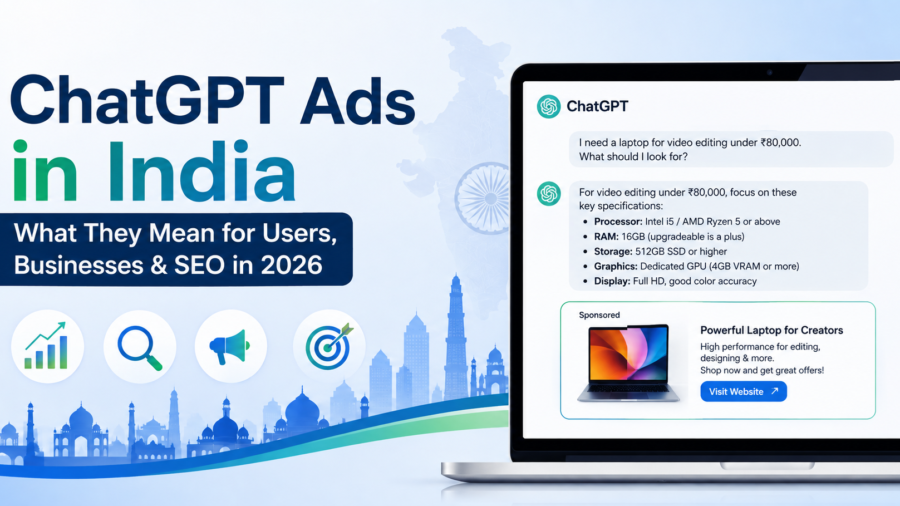
If you use ChatGPT on the Free or Go plan in India, you may have noticed something new: ads are starting to appear below some ChatGPT responses.
OpenAI began rolling out its advertising programme in India on August 27, 2026, making India one of the latest markets to get ChatGPT Ads. The initial rollout is aimed at logged-in adult users on the Free and Go plans, while Plus, Pro, Business, Enterprise and Edu remain ad-free. More than 50 brands are part of the initial Indian rollout, with WPP and Omnicom among the first agency partners.
For ordinary users, this raises an obvious question: Will these ads change the answers ChatGPT gives?
For businesses and SEO professionals, there is another question: Does this create a new advertising channel that could change how people discover brands online?
The answer to both is worth understanding before drawing conclusions.
ChatGPT Ads Have Arrived in India
The Indian rollout officially began on August 27, 2026.
OpenAI says ads may appear to eligible users when there is a relevant advertising opportunity. They are displayed separately from the normal ChatGPT response and are clearly marked as sponsored.
The rollout follows several months of testing in other markets. OpenAI first began testing ads with Free and Go users in the US in February 2026 and subsequently expanded the programme to additional countries.
India is particularly significant because ChatGPT has a very large user base here. TechCrunch reported that OpenAI said India had more than 100 million weekly active ChatGPT users earlier in 2026.
That makes India an important market not only for ChatGPT itself, but also for advertisers trying to reach people while they are researching products, services and ideas.
What Are ChatGPT Ads?
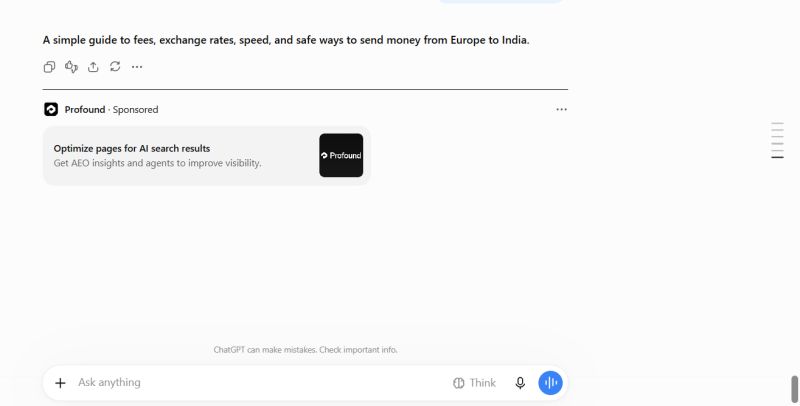
ChatGPT Ads are paid promotional placements that can appear below a ChatGPT response.
They are different from the text ChatGPT generates for the user. OpenAI says the advertising system operates separately from the system generating ChatGPT’s answers. Ads are also visually separated and labelled as sponsored.
Think about a simple example.
You ask:
“I need a laptop for video editing under ₹80,000. What specifications should I look for?”
ChatGPT might provide an ordinary answer explaining processors, RAM, storage, display and graphics requirements.
If there is a relevant advertisement, a sponsored placement may appear below that answer.
That is different from a traditional Google Search ad, where advertisements can appear above or below search results. It is also different from a social media ad, where the platform generally decides what appears in your feed.
ChatGPT’s advertising model is built around the context of a conversation.
OpenAI says its ad system can consider the current conversation’s context and intent, along with information supplied by advertisers about where their products or services may be relevant.
Who Will See Ads on ChatGPT in India?
For the current programme, ads are aimed at logged-in adult users on the Free and Go plans.
OpenAI says Plus, Pro, Business, Enterprise and Edu accounts do not have ads. It also says ads are not shown to accounts identified as belonging to people under 18.
There is also an important distinction for Free users. OpenAI currently provides an Ads-Free option for eligible Free users, although switching to it means accepting lower usage limits and reduced access to some features.
So seeing an advertisement does not mean every ChatGPT user in India will see the same advertising experience.
Where Do ChatGPT Ads Appear?
The most important thing to understand is the placement.
ChatGPT Ads appear below the ChatGPT response, rather than being inserted into the answer itself. OpenAI says advertisements are clearly labelled as sponsored and visually separated from the response.
An ad can include:
Advertiser name
Logo or favicon
Headline
Description
Image
Landing page
The advertising system decides whether an eligible advertisement is relevant to the conversation.
This is an important difference from simply showing a random banner.
For example, someone discussing home renovation could potentially encounter an advertisement related to flooring, furniture, renovation services or another relevant product.
That does not mean the advertiser has paid to become part of ChatGPT’s answer.
Do ChatGPT Ads Change the Answers You Get?
No. OpenAI says advertisers cannot change, rank or alter ChatGPT’s answers.
This is one of the most important principles behind the advertising programme.
OpenAI says ads operate separately from the chat model and do not influence the answers users receive. Seeing an advertisement also does not mean that OpenAI recommends or endorses the advertiser.
So there is a clear distinction:
ChatGPT answer: generated independently based on the conversation.
Advertisement: paid placement displayed separately below the response.
That distinction matters because users are likely to use ChatGPT for product research and recommendations. If paid placements could directly change answers, the line between advertising and organic information would become much harder to understand.
OpenAI has therefore made answer independence one of its stated advertising principles.
Can Advertisers See Your ChatGPT Conversations?
No. Advertisers do not receive your ChatGPT conversations, chat history or memories.
OpenAI says advertisers receive aggregated campaign information such as views and clicks rather than the contents of individual conversations. It also says advertisers do not receive users’ names, email addresses, precise locations, IP addresses or sensitive information.
There is, however, an important distinction between using conversation context to select an advertisement and giving that conversation to the advertiser.
OpenAI says information used to make ads relevant stays within ChatGPT. Depending on the user’s settings, this can include the current conversation and, where ad personalization is enabled, certain signals from past chats and memory.
In simple terms:
ChatGPT can use relevant signals to decide which ad may fit. The advertiser does not get to read your chat.
Users also have controls over ad personalization and can manage their advertising settings.
How ChatGPT Ads Could Change Online Advertising in India
This is where things become interesting for marketers.
Traditional search advertising is largely built around search queries and keywords.
For example:
“best running shoes under ₹5,000”
A user has entered a specific search.
A conversational platform can receive something much more detailed:
“I run five days a week, mostly on roads, and have a budget of ₹5,000. I want something comfortable that will last.”
The second interaction contains more context.
It tells a business more about what the person is trying to accomplish.
OpenAI’s current advertising system uses conversation context and intent as part of ad selection. Advertisers can also provide context hints describing the conversations, topics or keywords where their products may be relevant. OpenAI says these hints help guide matching but are not exact-match keywords and do not guarantee delivery.
That creates an interesting advertising environment.
Instead of thinking only about:
“Which keyword should I bid on?”
advertisers may increasingly need to think about:
“In what kind of conversation would my product actually be useful?”
That is a meaningful change in how marketers can think about paid discovery.
What ChatGPT Ads Mean for Indian Businesses
The opportunity will not look identical for every business.
A large e-commerce company may have thousands of products and strong landing pages. A SaaS company may want to reach people researching software. A travel company could be relevant when someone is planning a trip.
Some sectors that could potentially benefit include:
E-commerce
SaaS
Travel
Retail
Education
Financial services
Health and beauty
Consumer brands
Local businesses
Startups
But businesses should not assume that simply advertising on ChatGPT will produce results.
The basics still matter.
If someone clicks an advertisement and reaches a slow website with unclear pricing, poor mobile usability or weak product information, the advertising platform cannot solve that problem.
The same principle applies to SEO.
Getting the click is only one part of the journey.
The website still needs to convince the visitor.
What about smaller Indian businesses?
This is particularly interesting because OpenAI is introducing self-service advertising access in India.
According to reporting on the launch, ChatGPT Ads Manager is scheduled to become available to Indian businesses from September 4, 2026, with reported minimum daily campaign budgets starting at ₹725.
That makes the platform potentially accessible beyond large brands and major advertising agencies.
However, a ₹725 minimum does not mean ₹725 will guarantee traffic, leads or sales. It is simply a starting campaign budget reported for the self-service platform.
Businesses should judge the channel based on actual performance.
What ChatGPT Ads Mean for SEO
For SEO professionals, this is probably the most important part of the discussion.
ChatGPT Ads do not replace SEO.
Paid advertising and organic search visibility are different things.
SEO focuses on earning visibility through useful content, technical quality, relevance, authority, links, structured information and a strong overall website experience.
Advertising buys a promotional opportunity.
The two can work alongside each other.
Imagine a company selling accounting software in India.
Its SEO strategy might target searches such as:
accounting software for small businesses
GST accounting software
bookkeeping software
best accounting software for startups
Its content can answer those questions and build organic visibility over time.
Advertising, meanwhile, can provide paid exposure to people who are actively researching software.
The smart strategy is not:
SEO or ChatGPT Ads.
It is understanding where each channel fits.
SEO vs ChatGPT Ads: What’s the Difference?
OpenAI’s Ads Manager documentation currently lists CPM and CPC buying options, along with reporting for impressions, clicks, spend, CTR, average CPC, average CPM and conversions.
The important point for businesses is that these are different marketing channels, not two versions of the same thing.
Will ChatGPT Ads Replace Google Ads?
Probably not.
At least, there is no reason to treat the arrival of ChatGPT Ads as the end of Google Ads.
Google Search and ChatGPT serve different user experiences.
Someone searching Google may want a list of websites, products, maps, reviews or direct search results.
Someone using ChatGPT may want a conversation that helps them compare options, understand a problem or make a decision.
There will certainly be overlap.
A person could discover a brand through Google, see it on Instagram, compare it on Amazon and later ask ChatGPT whether it is a good option.
That means the advertising market may become more spread out rather than simply moving from one platform to another.
For marketers, this means understanding where customers make decisions becomes increasingly important.
Should Indian Businesses Start Preparing for ChatGPT Advertising?
Yes, but preparation does not necessarily mean immediately spending money.
There are several things businesses can do first.
1. Understand customer questions
Look beyond traditional keywords.
Find the questions people ask before buying your product or hiring your service.
2. Improve your website content
Make product and service information easy to understand.
Pricing, features, benefits, comparisons, policies and FAQs should not be hidden behind confusing navigation.
3. Strengthen landing pages
A paid click has value only when the landing page gives the visitor a good reason to continue.
4. Build brand trust
Reviews, testimonials, transparent business information and useful content can all help when someone is deciding between alternatives.
5. Track traffic properly
Use analytics and UTM parameters so you can distinguish paid ChatGPT traffic from other sources.
OpenAI’s advertising documentation says static tracking parameters such as UTM parameters can be added to landing page URLs.
6. Think about conversational intent
Instead of only asking which keyword has the highest search volume, ask what problem the customer is trying to solve.
7. Keep product and service information clear
If your website contains incomplete or confusing information, every discovery channel becomes harder to convert.
8. Watch the platform before scaling
The Indian advertising programme is still relatively new.
Businesses should test carefully, measure results and scale based on performance rather than excitement around a new platform.
What Marketers Should Watch in 2026
The most interesting part of ChatGPT advertising is that the platform is still being developed.
Marketers should keep an eye on:
Availability of ChatGPT Ads in different countries
Self-service Ads Manager features
Campaign objectives
CPC and CPM pricing
Conversion tracking
Measurement options
Audience controls
Advertiser adoption
User response to sponsored content
Changes in conversational search behaviour
OpenAI has already expanded its advertising tools during 2026, including CPC bidding, self-service campaign creation and additional measurement capabilities.
That suggests the advertising product is not finished yet.
For Indian marketers, the better approach is to watch how the channel performs rather than assuming it will automatically become the next major source of customers