

Hostinger Review 2026

Hostinger Review 2026: Still the Best Budget Host?

If you’re launching a new site or switching from an overpriced host, Hostinger is probably the name you keep hearing. It’s grown from a free web hosting service into one of the most recognized names in the industry, and we spent time testing it across shared, cloud, and VPS tiers to see if it still holds up in 2026.

One-line verdict: A top value pick for beginners, growing businesses, and budget-conscious site owners who want speed, reliability, and genuine ease of use without a steep learning curve.

Fast, Consistent Load Times

Page speed directly affects whether visitors stick around, and Hostinger delivers here. Across our shared hosting tests, average load times landed around 480-520ms noticeably faster than most Apache-based budget hosts. This comes down to Hostinger’s use of LiteSpeed web servers instead of the older Apache stack most competitors rely on. LiteSpeed also uses aggressive caching to serve repeat visitors even faster, which matters a lot for content-heavy sites and online stores.

Strong, Dependable Uptime

Shared and WordPress hosting plans hovered around 99.9%+ uptime over our monitoring period, and VPS tiers performed even more consistently with fewer interruptions. For most small-to-mid-sized websites, that level of reliability is more than enough to keep search rankings and customer trust intact.

Genuinely Great Value

What stands out about Hostinger isn’t just that it’s cheap it’s that the entry-level plans don’t feel stripped down. Even at the lowest tier, you get free SSL certificates, automated backups, and malware scanning bundled in, which many competitors reserve for higher-priced plans. Add in a free domain for the first year on annual terms (often with WHOIS privacy protection included), and the overall package feels far more generous than the price tag suggests.

An Interface Beginners Actually Enjoy

Hostinger built its own custom control panel, hPanel, instead of licensing the industry-standard cPanel and it shows. Everything is laid out logically, the setup wizard walks new users through the essentials, and you won’t need a tutorial just to find where your files or databases live. For anyone setting up their first website, this alone removes a huge amount of friction.

One-Click Installs for Everything

Installing WordPress, WooCommerce, Drupal, or PrestaShop takes a single click through Hostinger’s Auto Installer. There’s no manual database creation, no fiddling with config files just pick your app and it’s ready to go in minutes. This is especially valuable for non-developers who want to get a functional site live without touching code.

Hassle-Free Migrations

Switching hosts is often the biggest reason people avoid leaving a bad provider. Hostinger removes that friction with a free migration service you submit a request with a few details, and their team handles the technical transfer. WordPress migrations are largely automated and typically complete within 24-48 hours, meaning minimal downtime for your live site.

AI-Powered Website Builder

Every Hostinger plan includes a capable website builder with over 100 templates, plus an AI-assisted setup that can generate a customized site in minutes. It’s a strong option for anyone who wants a professional-looking site whether a portfolio, a service business page, or a full ecommerce store without hiring a designer or learning a page builder from scratch.

Global Infrastructure

Hostinger operates data centers across North America, South America, Europe, and Asia, including locations in the US, UK, Germany, India, Singapore, and Brazil. This lets you choose a server location close to your target audience, reducing latency. Business-tier plans and above also include CDN access, which further speeds up load times for visitors regardless of where they’re browsing from.

Support That Actually Helps

While Hostinger doesn’t offer phone support, its 24/7 live chat and ticket system consistently deliver clear, detailed answers. In our interactions, reps went as far as providing annotated screenshots to walk through exact steps a level of hand-holding that’s rare from a budget host.
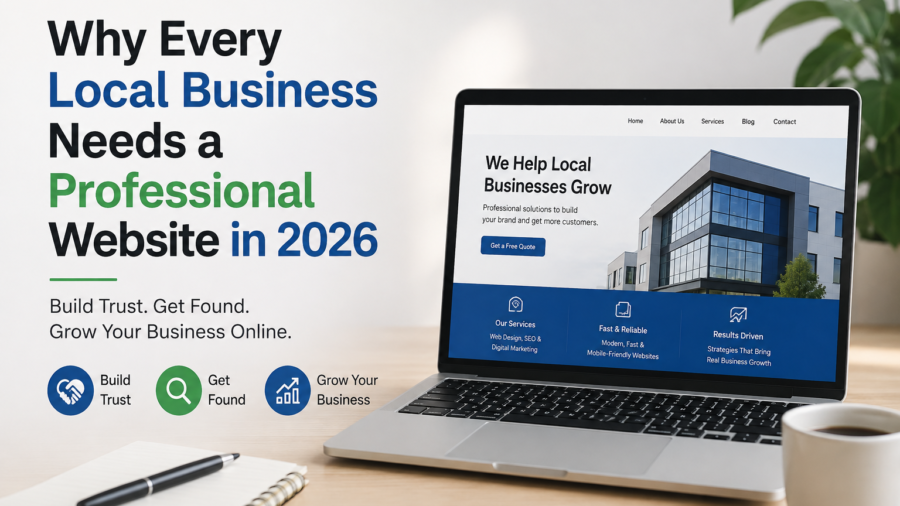
Why Every Local Business Needs a Professional Website in 2026

Why Every Local Business Needs a Professional Website in 2026

In 2026, customers in India are searching online before choosing a local business. Whether they need a doctor, coaching centre, property dealer, restaurant, salon, manufacturer, or service provider, Google is often the first place they look. This makes having a professional website for a local business more important than ever.

For businesses in cities like Ghaziabad and Bareilly, a well-designed website can help build trust, improve online visibility, generate enquiries, and turn local searches into potential customers.

1. Customers Are Searching Online

The way people find local businesses has changed significantly. Instead of asking friends or visiting multiple shops, customers can search for services online within seconds.

For example, someone in Ghaziabad may search for:

  • Best dentist in Ghaziabad
  • Website designer in Ghaziabad
  • Coaching centre near me
  • Property dealer in Ghaziabad

Similarly, customers in Bareilly may search for local restaurants, doctors, educational institutes, retailers, or professional services.

If your business does not have a professional online presence, potential customers may discover your competitors instead.

2. A Website Builds Trust

A professional website can make a local business look more credible and established.

Customers can visit your website to learn about your company, services, experience, customer reviews, location, and contact details. This information helps them understand your business before making a decision.

For example, a customer looking for a service provider in Ghaziabad may compare several businesses online. A clear and professional website can help your business make a stronger first impression.

Your website should communicate three things quickly:

What you offer, where you operate, and why customers should choose you.

3. Your Website Supports Local SEO

Having a website is also important for Local SEO.

Local SEO helps businesses become more visible when people search for products or services in a specific location. A properly optimized website can target relevant searches such as “service provider in Ghaziabad” or “business services in Bareilly.”

Important website elements for local SEO include:

  • Location-focused content
  • Optimized page titles and descriptions
  • Service pages
  • Internal linking
  • Mobile-friendly design
  • Fast loading speed
  • Relevant local information
  • Clear contact details

When combined with a properly optimized Google Business Profile, your website can become an important part of your local search strategy.

4. A Website Can Generate Leads 24/7

Your physical business may have fixed working hours, but your website can work around the clock.

A potential customer can visit your website at any time, understand your services, and contact you through a call, WhatsApp button, enquiry form, or email.

For example, a coaching centre in Bareilly could use a “Book a Free Counselling Session” button, while a property dealer in Ghaziabad could use “Talk to a Property Expert.”

Clear calls to action can turn website visitors into genuine enquiries.

5. Social Media Is Not a Replacement for a Website

Instagram, Facebook, and WhatsApp are valuable marketing channels, but they should not be your entire online presence.

Social media helps businesses engage with customers and build awareness. A website provides a central place where customers can find complete information about your business.

Think of it this way:

Social media helps people discover your business.

Your website helps them understand, trust, and contact your business.

Using both together can create a stronger digital presence.

6. A Professional Website Helps You Compete Locally

Small businesses don’t always need to compete with national brands. They can focus on attracting customers in their own service areas.

A salon can target customers in Ghaziabad. A coaching institute can focus on students in Bareilly. A local manufacturer can target buyers across nearby cities.

A website allows businesses to create dedicated service and location content that speaks directly to their target customers.

Conclusion

In 2026, a professional website is more than an online visiting card. For local businesses in Ghaziabad, Bareilly, and other Indian cities, it can support branding, Local SEO, customer trust, and lead generation.

Whether you run a clinic, coaching centre, restaurant, salon, property business, manufacturing company, or professional service, your website should make it easy for customers to find you, understand your services, trust your business, and take action.

A well-planned website can become the foundation of your digital marketing strategy and help your local business grow in an increasingly competitive Indian market.

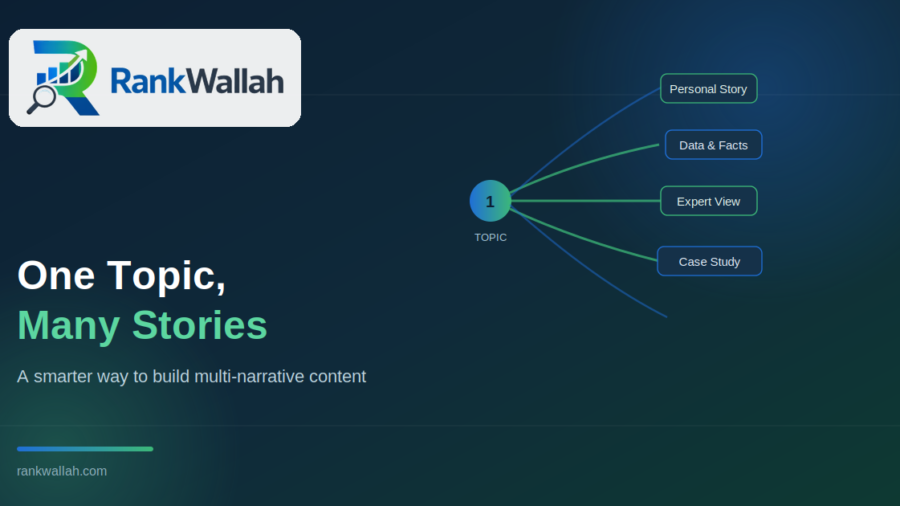
One topic many stories multi-narrative content strategy diagram - RankWallah

One Topic, Many Stories: Why Smart Creators Stop Writing the Same Article Twice

Most content calendars are built like a checklist. Pick a topic, write the post, check it off, move to the next topic. It’s efficient — and it’s also why so much content feels forgettable. The fix isn’t writing more topics. It’s writing more stories about the same one.

Think about how a good documentary series works. It doesn’t explain its subject once and stop. It returns to the same subject from a dozen directions — an interview here, an archival clip there, a personal account, a data point, a counterargument — and by the end you understand the subject in a way no single 20-minute segment could have delivered. That’s the model worth stealing for content strategy: treat your topic less like a single article and more like a subject you’re allowed to revisit, again and again, from a different angle each time.

Why One Angle Isn’t Enough Anymore

A topic rarely has just one audience. Take something as ordinary as “freelancing.” A beginner wants reassurance and a starting checklist. A five-year veteran wants tax strategy and burnout management. A client hiring freelancers wants to know how to vet one. All three are interested in the same broad subject, but a single article can’t serve all of them without becoming shallow for everyone.

This is also, increasingly, how search engines read authority. A site that publishes one isolated post about freelancing looks like it dabbled in the topic. A site that’s published a beginner’s guide, a deep-dive on freelance taxes, a client-side hiring guide, and a few personal case studies looks like it actually knows the subject — and search algorithms reward that depth with better rankings, not just better reader satisfaction.

There’s a human reason too. Data convinces the analytical mind, but it rarely moves anyone emotionally. A personal story does the opposite — it sticks, but it doesn’t always carry weight or evidence on its own. When you tell a topic through multiple stories, you can give one piece to the head and another to the heart, instead of forcing a single article to awkwardly do both jobs at once.

A Worked Example

Say your subject is “the four-day workweek.” Instead of one explainer post, you could build:

  • The skeptic’s story — a mid-size company that tried it, struggled with client expectations, and rolled it back. Honest, not promotional.
  • The convert’s story — a team that redesigned its meetings and workflows and now genuinely produces more in four days than five.
  • The numbers story — what the pilot studies actually show, stripped of hype, with the caveats nobody puts in the headline.
  • The manager’s story — practical advice for someone trying to propose this to leadership without sounding naive.

Each piece stands on its own. Together, they cover doubt, success, evidence, and execution — the four things any reader actually needs before they can form a real opinion on the topic.

A Simple Framework to Build This Yourself

1. Pick a topic with enough surface area. Not every subject supports multiple stories. “How to reset a router” doesn’t. “Return to office policies” does, because it touches employees, managers, real estate costs, and culture all at once. Look for topics where reasonable people disagree, or where different groups experience the same event differently.

2. List who actually cares, and why they care differently. Don’t brainstorm angles in the abstract — brainstorm audiences first. A parent, a teacher, and a policymaker can all care about “screen time,” but their stakes and questions barely overlap.

3. Match each angle to its natural format. A personal story usually wants narrative prose. A skeptical or technical angle wants data and structure. A practical angle wants a checklist or steps. Don’t force every angle into the same template just because it’s convenient.

4. Build the connective tissue before you publish. This is the step people skip. If your four stories don’t link to each other and don’t share a recognizable thread — a consistent framing, a recurring visual, a one-line reminder of the bigger theme — they’ll just read as four unrelated posts that happen to share a tag. The cluster only works if a reader can feel the seams connecting them.

5. Stagger the release. Publishing all four pieces in one day buries them in your own feed. Spacing them out gives each story its own moment, and gives you something to link back to as you go.

Where This Goes Wrong

The most common failure isn’t lack of ideas — it’s redundancy disguised as variety. Four stories that all say the same thing in slightly different tones aren’t four stories; they’re one story with four headlines. Before publishing, ask honestly: if someone read only one of these, would they walk away thinking something genuinely different than if they’d read another? If the answer is no, merge them or rethink the angles.

The second failure is one-sidedness. If every “different perspective” happens to support the same conclusion, you haven’t built a multi-narrative piece — you’ve built one argument wearing several disguises. The strength of this approach is that it can hold tension between conflicting views without resolving it artificially.

The Takeaway

A topic isn’t a box you check once. It’s a subject you’re allowed to come back to, as many times as it has honest angles to offer. The brands and writers who do this well aren’t publishing more for the sake of volume — they’re publishing more because they’ve recognized that no single story was ever going to be enough to do the topic justice.