
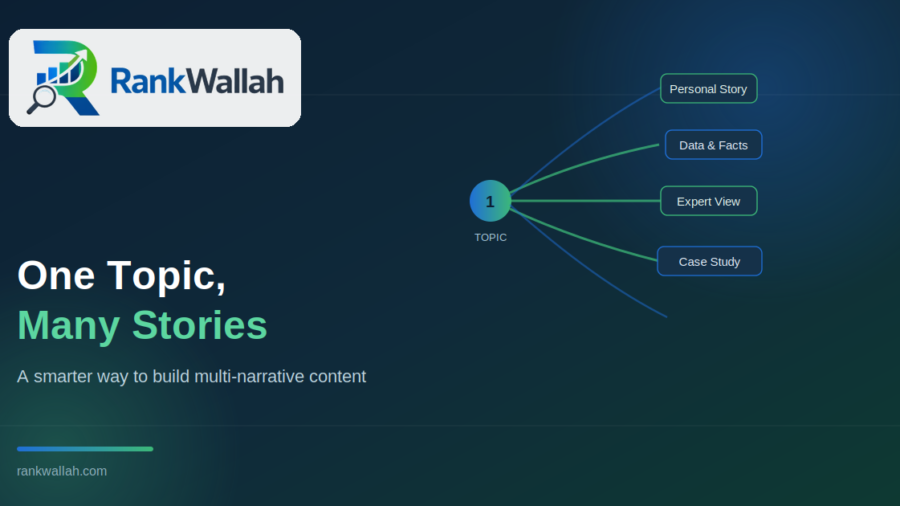
Most content calendars are built like a checklist. Pick a topic, write the post, check it off, move to the next topic. It’s efficient — and it’s also why so much content feels forgettable. The fix isn’t writing more topics. It’s writing more stories about the same one.
Think about how a good documentary series works. It doesn’t explain its subject once and stop. It returns to the same subject from a dozen directions — an interview here, an archival clip there, a personal account, a data point, a counterargument — and by the end you understand the subject in a way no single 20-minute segment could have delivered. That’s the model worth stealing for content strategy: treat your topic less like a single article and more like a subject you’re allowed to revisit, again and again, from a different angle each time.
Why One Angle Isn’t Enough Anymore
A topic rarely has just one audience. Take something as ordinary as “freelancing.” A beginner wants reassurance and a starting checklist. A five-year veteran wants tax strategy and burnout management. A client hiring freelancers wants to know how to vet one. All three are interested in the same broad subject, but a single article can’t serve all of them without becoming shallow for everyone.
This is also, increasingly, how search engines read authority. A site that publishes one isolated post about freelancing looks like it dabbled in the topic. A site that’s published a beginner’s guide, a deep-dive on freelance taxes, a client-side hiring guide, and a few personal case studies looks like it actually knows the subject — and search algorithms reward that depth with better rankings, not just better reader satisfaction.
There’s a human reason too. Data convinces the analytical mind, but it rarely moves anyone emotionally. A personal story does the opposite — it sticks, but it doesn’t always carry weight or evidence on its own. When you tell a topic through multiple stories, you can give one piece to the head and another to the heart, instead of forcing a single article to awkwardly do both jobs at once.
A Worked Example
Say your subject is “the four-day workweek.” Instead of one explainer post, you could build:
- The skeptic’s story — a mid-size company that tried it, struggled with client expectations, and rolled it back. Honest, not promotional.
- The convert’s story — a team that redesigned its meetings and workflows and now genuinely produces more in four days than five.
- The numbers story — what the pilot studies actually show, stripped of hype, with the caveats nobody puts in the headline.
- The manager’s story — practical advice for someone trying to propose this to leadership without sounding naive.
Each piece stands on its own. Together, they cover doubt, success, evidence, and execution — the four things any reader actually needs before they can form a real opinion on the topic.
A Simple Framework to Build This Yourself
1. Pick a topic with enough surface area. Not every subject supports multiple stories. “How to reset a router” doesn’t. “Return to office policies” does, because it touches employees, managers, real estate costs, and culture all at once. Look for topics where reasonable people disagree, or where different groups experience the same event differently.
2. List who actually cares, and why they care differently. Don’t brainstorm angles in the abstract — brainstorm audiences first. A parent, a teacher, and a policymaker can all care about “screen time,” but their stakes and questions barely overlap.
3. Match each angle to its natural format. A personal story usually wants narrative prose. A skeptical or technical angle wants data and structure. A practical angle wants a checklist or steps. Don’t force every angle into the same template just because it’s convenient.
4. Build the connective tissue before you publish. This is the step people skip. If your four stories don’t link to each other and don’t share a recognizable thread — a consistent framing, a recurring visual, a one-line reminder of the bigger theme — they’ll just read as four unrelated posts that happen to share a tag. The cluster only works if a reader can feel the seams connecting them.
5. Stagger the release. Publishing all four pieces in one day buries them in your own feed. Spacing them out gives each story its own moment, and gives you something to link back to as you go.
Where This Goes Wrong
The most common failure isn’t lack of ideas — it’s redundancy disguised as variety. Four stories that all say the same thing in slightly different tones aren’t four stories; they’re one story with four headlines. Before publishing, ask honestly: if someone read only one of these, would they walk away thinking something genuinely different than if they’d read another? If the answer is no, merge them or rethink the angles.
The second failure is one-sidedness. If every “different perspective” happens to support the same conclusion, you haven’t built a multi-narrative piece — you’ve built one argument wearing several disguises. The strength of this approach is that it can hold tension between conflicting views without resolving it artificially.
The Takeaway
A topic isn’t a box you check once. It’s a subject you’re allowed to come back to, as many times as it has honest angles to offer. The brands and writers who do this well aren’t publishing more for the sake of volume — they’re publishing more because they’ve recognized that no single story was ever going to be enough to do the topic justice.