
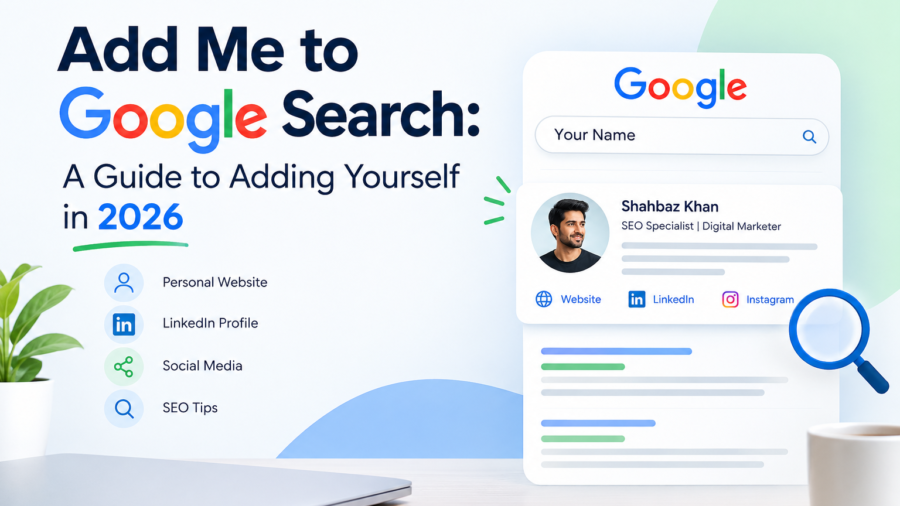
Have you ever searched for your name on Google and found little or no information about yourself? If you want people to find your name, work, or professional profile online, you can take a few simple steps to improve your visibility.
“Add Me to Google Search” usually refers to making your personal information easier to discover through Google. There is no single form that guarantees your name will appear in search results. Instead, you can create public profiles, build a personal website, and help Google discover your online information.
In this guide, you will learn how to make yourself more visible on Google in 2026.
What Does “Add Me to Google Search” Mean?
Adding yourself to Google Search means creating an online presence that Google can find and potentially show in its search results.
For example, if you are a freelancer, student, business owner, or digital marketing professional, you may want people to find your name, experience, skills, or website when they search for you.
Google discovers public web pages and decides which ones to include in its search results. You cannot manually add every personal detail to Google or guarantee a particular ranking.
Is Google People Card Still Available in 2026?
Google People Cards were introduced to help individuals create a simple public profile that could appear in Google Search. Users could share information such as their name, occupation, location, and professional details.
However, Google discontinued the People Cards feature in 2024. As a result, you cannot create a new Google People Card using the old feature in 2026.
The good news is that you can still build your online presence through other methods, including a personal website, LinkedIn, and public professional profiles.
How to Add Yourself to Google Search in 2026
Follow these practical steps to help people discover your name and professional information online.
1. Create a Personal Website
A personal website is one of the best ways to present your information in one place. You can use it to introduce yourself, share your skills, display your work, and provide contact details.
You can create a website using platforms such as WordPress or other website builders.
Include the following information:
- Your full name
- A short introduction about yourself
- Your profession and skills
- Your work experience or portfolio
- Links to your professional profiles
- Contact information you are comfortable sharing publicly
For example, a freelance SEO specialist could create a website with a homepage, an About page, and a portfolio showing previous projects.
Use your name naturally in the page title and main heading. Make sure the website works on mobile devices and loads properly.
2. Create or Improve Your LinkedIn Profile
LinkedIn is a professional platform where you can share your experience, skills, education, and achievements. Public LinkedIn profiles may appear in Google Search results.
To improve your profile:
- Use your real professional name.
- Add a clear headline describing your work.
- Complete your About section.
- Include relevant experience, skills, and education.
- Add a professional profile photo if you wish.
- Review your public profile visibility settings.
For example, a headline such as “SEO Specialist | Technical SEO | AI Search Optimization” helps visitors understand your professional focus.
Keep your information accurate and updated. A complete profile can help people understand your expertise when they find you online.
3. Make Your Social Media Profiles Discoverable
Public social media profiles can also help people find you through Google. Depending on the platform and its settings, public profiles and posts may appear in search results.
Use a consistent name and professional description across platforms such as Instagram, Facebook, and other relevant networks.
If you use social media for work, share useful information related to your field. For example, a web designer could post website projects, design tips, and examples of completed work.
Before making a profile public, review its privacy settings. Avoid sharing private details such as your home address, personal phone number, or sensitive documents.
4. Check Whether Google Has Indexed Your Website
Creating a website does not mean it will immediately appear on Google. Google must discover and index the page before it can usually show it in search results.
You can perform a quick check by searching:
site:yourwebsite.com
Replace yourwebsite.com with your actual domain.
This search can show some pages from your website that Google has indexed. However, it is not a complete or perfectly up-to-date list.
You can also use Google Search Console to check indexing information and submit a sitemap.
If a page is not appearing, check whether it is publicly accessible, blocked from indexing, or affected by technical issues. Remember that submitting a page does not guarantee indexing.
5. Create Helpful Content About Your Work
Publishing useful content gives people more opportunities to discover your name online.
You could publish articles, project case studies, tutorials, or professional insights on your website. Choose topics that match your experience and the questions people commonly ask in your field.
For example, a digital marketer could write about keyword research, website audits, or improving local search visibility.
Use clear titles, descriptive headings, and accurate information. Link to relevant pages on your website and to your public professional profiles where appropriate.
Focus on helping readers rather than publishing many low-quality pages just to appear in search results.
6. Keep Your Information Consistent
Try to use the same professional name and a similar description across your website and public profiles. This can help visitors recognise that different pages belong to the same person.
You can also link your website to your LinkedIn profile and other relevant professional accounts.
If you have a personal website, make your About page clear and explain your background, work, and areas of expertise. Keep the information truthful and update it when your experience changes.
Consistency can support your online identity, but it does not guarantee that Google will connect every profile or rank your pages higher.
How Long Does It Take for Your Name to Appear on Google?
There is no fixed time. Google may discover and index a new page within days, but it can also take weeks or longer. Some pages may never be indexed.
The time depends on factors such as website accessibility, technical setup, content quality, and Google’s crawling and indexing systems.
You can use Google Search Console to monitor your website and check for indexing problems.
Frequently Asked Questions
Can I add my name to Google Search for free?
Yes. You can create public professional profiles and use Google Search Console for your website without paying Google for inclusion. Website hosting or certain services may have separate costs.
Can I create a Google People Card in 2026?
No. Google discontinued People Cards in 2024, so the original feature is no longer available for creating new cards.
How can I make my name appear first on Google?
There is no guaranteed method to rank first. Build a useful website, maintain accurate professional profiles, publish helpful content, and follow basic SEO practices. Results depend on Google’s systems and the search query.
Why is my name not showing on Google?
Your online profiles or website may not have been discovered or indexed yet. Your name may also be shared by many other people, making your pages harder to find. Check your public profile settings and use Google Search Console if you own a website.
Do I need a website to appear on Google?
No. Public professional profiles and other online pages may appear in Google Search without a personal website. However, a website gives you more control over how you present your experience and work.
Conclusion
Getting your name discovered on Google in 2026 is about building a clear and trustworthy online presence. Since Google People Cards are no longer available, focus on your personal website, LinkedIn profile, public professional accounts, and useful content.
Start with one or two steps, keep your information accurate, and give Google time to discover your pages. Although visibility is never guaranteed, a helpful and consistent online presence makes it easier for people to learn about you and your work.